Equal Opportunities Commission report shows modest gains in gender budget compliance, flags persistent inequalities
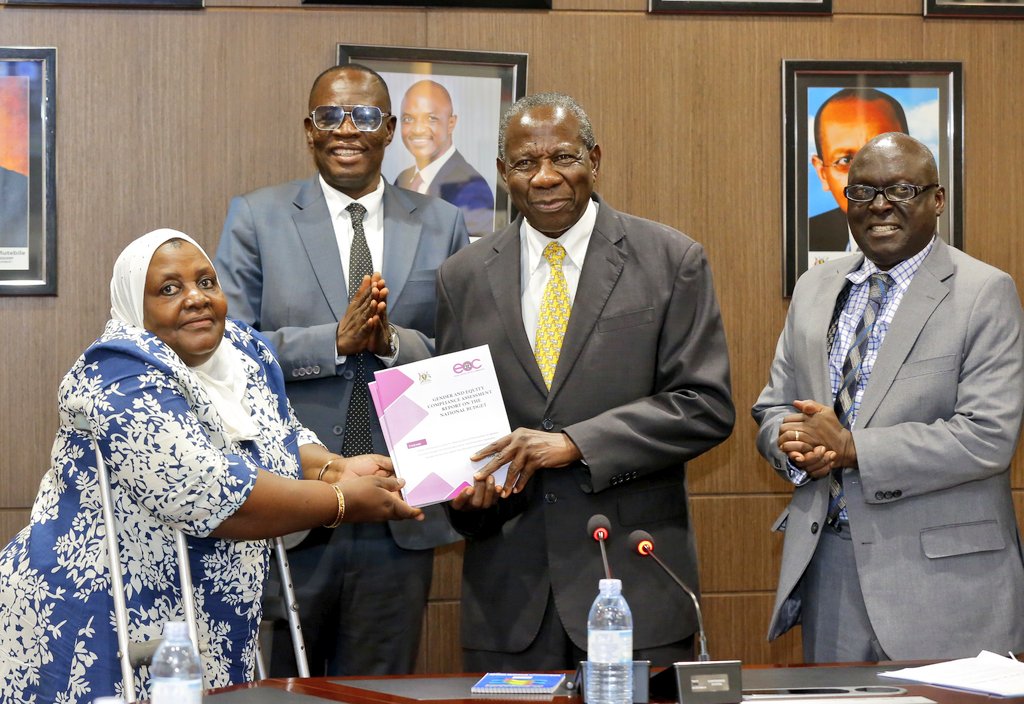
Finance Minister Matia Kasaija on Thursday received the Gender and Equity Compliance Assessment Report for the FY 2026/27, presented by EOC Chairperson Safia Nalule Juuko.
The government has registered modest progress in aligning the national budget with gender and equity requirements, but significant gaps remain, according to the latest assessment by the Equal Opportunities Commission (EOC).
Finance Minister Matia Kasaija on Thursday received the Gender and Equity Compliance Assessment Report for the FY 2026/27, presented by EOC Chairperson Safia Nalule Juuko.
The report indicates that overall compliance with gender and equity requirements has improved to 70 percent, up from 68 percent in the previous financial year. The national budget scored 67 percent, while ministerial policy statements averaged 70 percent.
Kasaija described the assessment as a critical accountability tool under the Public Finance Management Act, noting that it plays a key role in ensuring that public resources are allocated fairly.
“Government remains firmly committed to ensuring that public resources are allocated in a manner that promotes inclusive growth and addresses structural inequalities,” he said.
Despite the improvement, the EOC flagged several persistent challenges undermining full compliance. These include inadequate attention to regional disparities in planning and budgeting, as well as failure by some ministries, departments and agencies to adhere to reservation schemes intended to promote inclusion of marginalized groups.
Juuko noted that while progress is evident, more deliberate action is needed to ensure that equity considerations are systematically integrated into all government programmes.
Health Access Gaps in Hard-to-Reach Areas
In a separate report, the Commission highlighted both progress and ongoing challenges in access to healthcare services in Uganda’s island and mountainous regions.
The assessment shows that government interventions under the National Development Plans have led to improvements in service delivery. These include upgrading health facilities, expanding outreach through Village Health Teams, deploying mobile clinics and digitising health systems. Investments in climate-resilient infrastructure and emergency response frameworks have also strengthened healthcare access.
However, the report underscores persistent barriers in hard-to-reach districts. Many areas continue to face critical shortages of health workers, limited ambulance and emergency transport services, and inadequate health infrastructure.
Geographical challenges remain a major obstacle, with island communities heavily reliant on water transport and mountainous regions grappling with poor road networks. High transport costs, weak communication systems and ongoing disease burdens, particularly HIV and maternal health challenges, continue to disproportionately affect these populations.
The Commission warned that without targeted investments in staffing, transport systems and localised health solutions, the goal of equitable healthcare access will remain elusive.
While acknowledging government efforts, the EOC called for accelerated action to bridge the service delivery gap and ensure that vulnerable communities are not left behind.
The findings come as Uganda intensifies efforts to promote inclusive growth and equitable access to public services, placing renewed focus on how budgets translate into real outcomes for underserved populations.