Who is benefitting from road construction delays?
Six years later, the road is still under construction and, Ms. Nabweteme says, she has not yet been compensated for her quarter an acre piece of land to pave way for the construction of the road.
By Sasha Achola and Monica Kuei
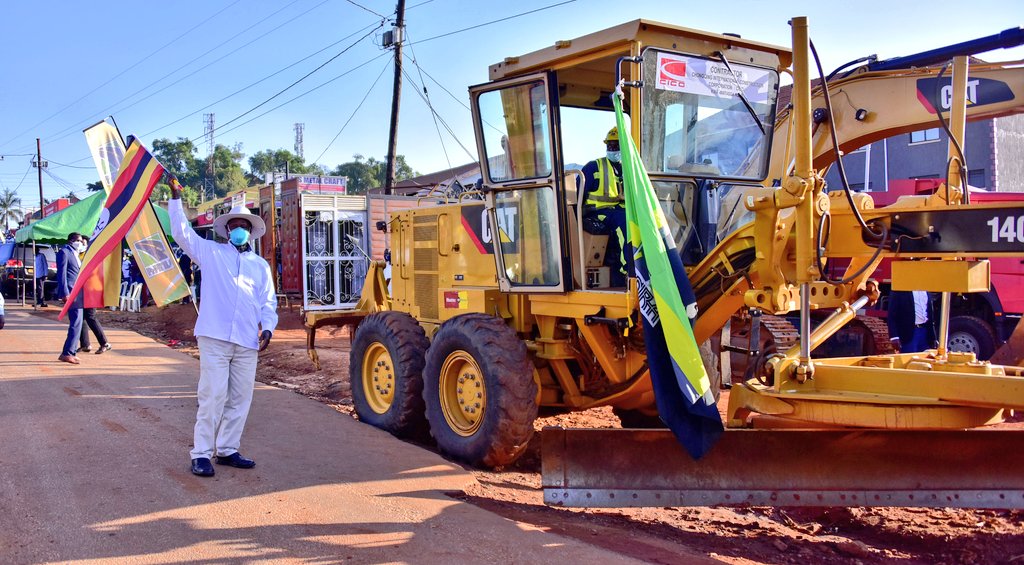
Catherine Nabweteme, 62, is a resident of Kirwanira Cell, Gombe Division, Nansana Municipality in Wakiso District who stays along the Kyaliwajjala-Kira–Kasangati–Matugga Road, which President Yoweri Kaguta Museveni launched its construction in December 2020.
The launch of the 23-kilometer road was carried out at Kyaliwajjala Trading Centre after signing and handing over of the fully funded Government of Uganda project to Chinese firm/contractor Chongqing International Construction Corporation (CICO) at a cost of Ush 200 billion.
Six years later, the road is still under construction and, Ms. Nabweteme says, she has not yet been compensated for her quarter an acre piece of land to pave way for the construction of the road.
For Samuel Kazibwe, his father John Bosco Sseruyange died in 2024, a few months after the valuation process and had handed in his Bank account number where the money for compensation would be deposited.
“We do not know whether we will even get that money. Our father died before we could be paid/compensated and he was a single signatory to his bank account. Even the land value has far changed from the value it was in 2020,” notes Kazibwe.
Many such people especially on the Kiti–Matugga road stretch, which is about 4 kilometers of the road, still hold such complaints of not having been compensated yet, despite the road completion date now set for July 2027.
“People from UNRA (Uganda National Roads Authority) came and valued our land for compensation for the road around Covid time but up to now, they have not paid us.
“They told us not to carry out any development projects on the land after valuation,” says Nabweteme.
Despite road projects delaying for reasons like land acquisition and compensation, where government has failed to compensate the Project Affected Persons like Nabweteme in time, there are other reasons of utility allocation (Water and Sewerage pipes, Electricity), design adjustments, slow cash flow and contractor mobilization issues.
For the Mpererwe–Kiteezi–Kiti Road, which links up with the Kyaliwajjala–Kira–Kasangati–Matugga Road at Kiti Junction, its construction was finally launched in May this year, after years of stalling.
Kampala Capital City Authority officials together with those from Wakiso District, launched the 9.1-kilometer road to ease traffic jam on the Kasangati–Gayaza road.
The Ush 50 billion project under the Kampala City Roads Rehabilitation Project was contracted to China Communications Construction Company (CCCC). It is off Gayaza road in Kawempe Division.
Ivan Kiseka, a taxi operator in Mpererwe Taxi Park notes the road has been in a bad state for a long time which makes his and other colleagues’ vehicles in and out of garages due to mechanical breakdowns and wishes it to be done as soon as possible.
Christopher Mutibwa, a Boda Boda Cyclist at Mpererwe Kayembe Stage complains of disruptions and the dust they have had to endure because of this delay.
Timothy Ssemakula, a 50-year-old resident of Namere Cell says he has to deal with flu like allergic reactions due to the dust that is as a result of delays in this project.
These and many others urge Government and Kampala Capital City Authority (KCCA) to work within a short period of time possible such that they can resume their businesses normally.
However, while recently carrying out a fact-finding mission on the delayed road projects, Uganda’s Minister for Works and Transport Mr. Fred Byamukama blamed collusion and corruption as the key reasons why government road projects delay.
“Delays are not technical, they are deliberate corruption,” says Byamukama.
He says during his inspections in June to August 2026 on Mityana–Mubende Road, Masaka–Kyotera–Mutukula Road, Busega–Mpigi Expressway and Kyaliwajjala–Kira–Kasangati–Matugga Road, he found that corruption inside the Ministry itself and inflated compensation are the major causes of road construction delays, benefitting mostly ministry officials.
“The issue of corruption has really contributed much to the failure of these projects. Some delays are deliberately created in approving designs, processing certificates and handling contract variations, eventually increasing the cost of projects.
“Ministry officials create delays on purpose so government pays interest and extra claims. Officials own the buildings on the road reserve. They are the ones who determine how much money these properties will be paid for. They set an exorbitant compensation amount,” notes Byamukama.
He gave an example of the Kisubi–Nakawuka–Nateete compensation that rose 3 times the cost of building the road to over Ush 400 billion just for land compensation.
Byamukama specifically named the Kyaliwajjala–Kira–Kasangati–Matugga Road where ministry officials constructed expensive buildings and fuel stations, which were eventually paid for.
He says Contractors asking for more money through fake claims like negotiation time, being given designs they can’t implement, signing contracts before fully securing land for the road project and contractors who are inefficient are some of the other key factors leading to road construction delays.
How people have been affected by the road construction delays
According to Emmanuel Muhabuzi, a Boda Boda Rider along the Wandegeya–Mulago–Kamwokya Road, because of the road construction, they spend more time in traffic jams or sometimes have to use longer alternative routes, consuming more fuel and make fewer trips a day.
He says some of their passengers complain of dust during dry seasons and the roads become muddy during rainy season.
Aldrine Arihoa Shop Attendant along the same road says the road closures and diversions have led to a decline in the number of his customers hence reducing his sales.
“We want the roads to be constructed but what is frustrating is the long period of time taken while constructing them,” notes Ariho.
Noah Habaasa, a Taxi Driver who plies Wankulukuku–Kabowa–Kitebi Road says the closure for construction works on Suuna Road a 4 kilometer road in Rubaga Division, Kampala City has forced them to use other alternative routes that are longer to take passengers to their destinations yet charging the same transport fares.
“We cannot increase transport fares yet we are taking longer routes. If we increase, people will resort to walking, others will use Boda Bodas while other taxis will not increase and you lose out on the business,” adds Habaasa.
Irene Nakato, a trader in Ndeeba, shares how the prolonged Ssuuna Road construction is impacting her business. “Since Ssuuna Road construction started last year, our goods are constantly covered in dust especially during dry seasons. The excavation works emit too much noise, dust and in the rainy seasons, the place is too muddy. It is difficult for customers to buy from us or reach us,” narrates Nakato.
For Moses Ssemanda, a Boda Boda Rider in Rubaga Division, they had to relocate their Boda Bodas stage because of the dragging of the construction of the road they had their first stage.