Judicial Training Institute, partners train labour officers to strengthen labour justice in Uganda
The training seeks to strengthen labour justice, improve workplace dispute resolution and enhance the enforcement of labour laws across the country. It is equipping Labour Officers with practical skills in conciliation, mediation, arbitration, labour inspection, case management and the application of Uganda’s labour laws.
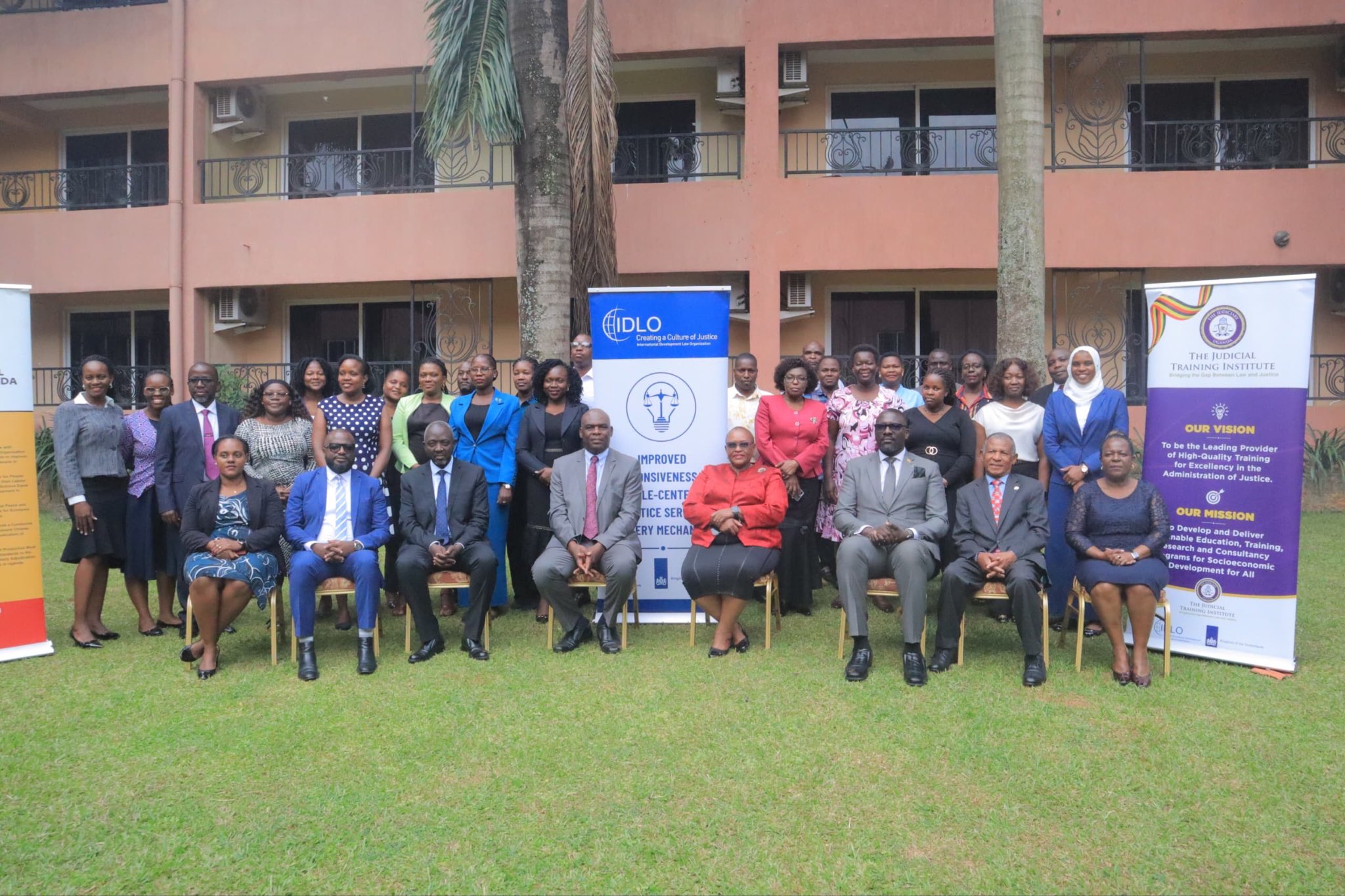
The Judicial Training Institute (JTI), in partnership with the Ministry of Gender, Labour, and Social Development (MGLSD) and the Industrial Court, and with support from the International Development Law Organization (IDLO), has launched a four-day regional capacity-building programme for labor officers from Uganda’s central region.
The training seeks to strengthen labour justice, improve workplace dispute resolution, and enhance the enforcement of labour laws across the country. It is equipping labor officers with practical skills in conciliation, mediation, arbitration, labour inspection, case management, and the application of Uganda’s labour laws.
The programme has attracted judicial officers from the Industrial Court and JTI, alongside key figures including retired Industrial Court Judge Justice Asaph Ruhinda Ntengye and Hon. Dora Christine Kanabahita Byamukama.
Speaking at the official opening, JTI Governing Council Chairperson and Supreme Court Justice Mike Chibita described the training as a major milestone in improving Uganda’s labour justice system.
Justice Chibita said the programme is the first in a nationwide series of regional trainings aimed at ensuring labor officers receive uniform knowledge and skills in labour law, procedures and mediation practices.
He commended the collaboration between JTI, MGLSD, the Industrial Court, and IDLO, noting that partnerships are vital in developing a competent labour justice system capable of addressing emerging workplace challenges.
Justice Chibita revealed that a labor officer handles an average of 10 cases daily, while the Industrial Court continues to manage a significant backlog of labour disputes. He urged stakeholders to strengthen first-instance dispute resolution mechanisms to ensure more cases are resolved before reaching the court.
The training covers key areas including labour law, jurisdiction, case management, hearing procedures, evidence evaluation, labour relations, Alternative Dispute Resolution (ADR), implementation of the Employment (Amendment) Act, 2026, and emerging issues such as the gig economy, migrant labour and child labour.
Justice Chibita encouraged participants to actively engage during the training and apply the knowledge gained to improve dispute handling in their respective districts.
He reminded labor officers that their role, like that of judicial officers, requires impartiality and professionalism, stressing that their duty is to administer justice fairly and according to the law rather than favouring employers or employees.
The initiative is expected to improve consistency in labour dispute resolution, strengthen documentation and reporting systems, reduce unnecessary referrals to the Industrial Court, and increase public confidence in Uganda’s labour justice system.