Budget Month: Government sets stage for growth with strategic investments in key economic sectors
As Uganda prepares for the budget reading on June 11, analysts say the success of the government's economic transformation agenda will depend not only on increased funding but also on effective implementation, accountability and the ability to translate macroeconomic growth into tangible improvements in household incomes and employment.
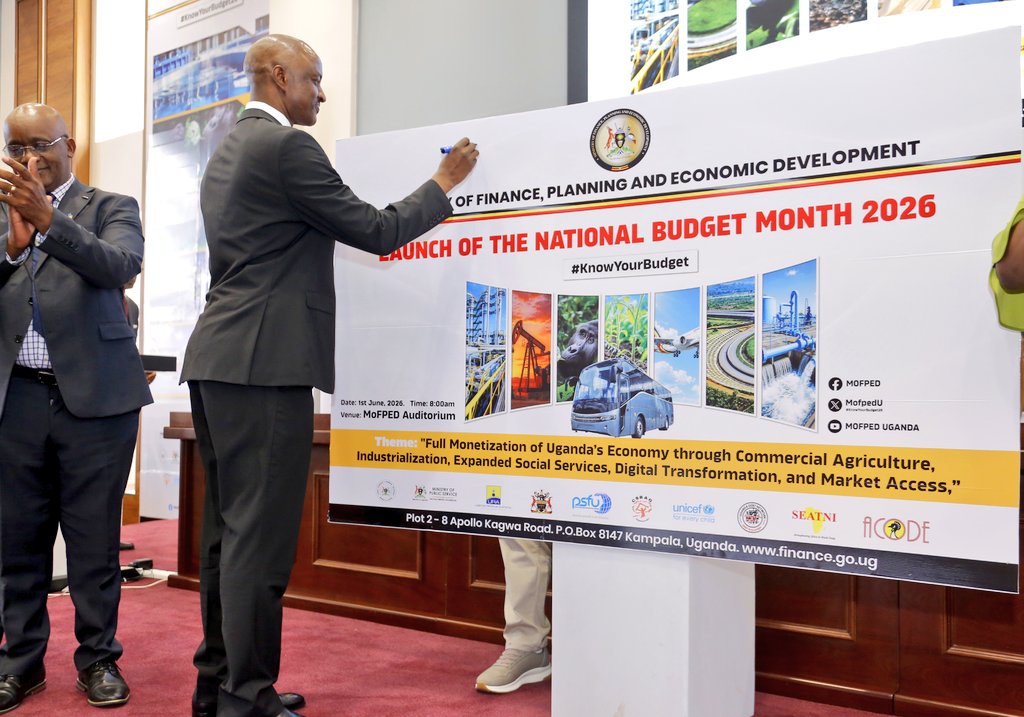
The government has launched Budget Month activities ahead of the presentation of the 2026/27 National Budget, outlining an ambitious economic transformation agenda centred on commercial agriculture, industrialisation, digital innovation and expanded market access.
Speaking at the launch of the National Budget Month, Ramathan Ggoobi said the government remains focused on achieving its target of growing Uganda’s economy tenfold by 2040 through strategic investments in key productive sectors and supporting infrastructure.
The 2026/27 budget will be implemented under the theme: “Full Monetization of Uganda’s Economy through Commercial Agriculture, Industrialization, Expanding and Broadening Services, Digital Transformation and Market Access.”
The theme signals a continued shift towards wealth creation and value addition, with policymakers seeking to move more Ugandans from subsistence activities into the money economy.
ATMS Sectors at the Centre of Growth Strategy
According to the Ministry of Finance, economic growth efforts will continue to focus on the government’s priority sectors known as ATMS — Agro-industrialisation, Tourism, Mineral-based industrialisation and Science, Technology and Innovation.
The strategy is designed to accelerate structural transformation by increasing production, processing and exports while creating jobs across the economy.
Agriculture, which employs the majority of Ugandans, is expected to remain a major beneficiary of government interventions. Officials say emphasis will be placed on value addition, agro-processing and commercial farming to boost household incomes and export earnings.
Tourism is also expected to receive increased support as Uganda seeks to capitalize on growing international arrivals and strengthen its position as a regional tourism destination.
Meanwhile, investments in mineral-based industrialisation, particularly in the oil and gas sector, are expected to drive industrial growth and attract new capital into the economy.
The government is also banking on science, technology, innovation and ICT to improve productivity and create opportunities for young entrepreneurs in the digital economy.
Infrastructure Investments to Support Growth
To unlock the potential of these sectors, government plans to continue investing in critical enablers of economic growth.
These include transport infrastructure, electricity generation and distribution, irrigation systems, industrial parks, education and healthcare services, as well as domestic resource mobilisation.
Economists have long argued that improving infrastructure and reducing production costs are essential for increasing the competitiveness of Ugandan businesses in regional and international markets.
The government says expanding digital infrastructure will also be a key priority as it seeks to deepen digital transformation across public services and the private sector.
Mobilising Resources for Development
A key focus during Budget Month will be explaining how government intends to mobilise the resources required to finance its development agenda.
Uganda continues to face increasing expenditure demands amid pressure to maintain fiscal discipline and manage public debt levels.
Finance officials say strengthening domestic revenue collection remains critical to funding development priorities while reducing reliance on external borrowing.
The budget communication campaign will also seek to inform citizens and businesses about opportunities emerging from government investments and encourage participation in priority sectors.
Broad Consultations Shaped the Budget
Dr. Ggoobi noted that preparations for the 2026/27 budget began in July 2025 and involved extensive consultations with stakeholders across the country.
The process included engagements with the President, Cabinet, Parliament, local governments, development partners, the private sector, civil society organisations, academia, youth and women groups, persons with disabilities, community leaders and ordinary citizens.
According to the Treasury, the consultations were aimed at ensuring that the budget responds to the needs of different sectors while supporting Uganda’s long-term development goals.
Business Community Watching Closely
For the private sector, the upcoming budget will be closely watched for measures aimed at improving the business environment, stimulating investment and expanding access to markets.
Businesses are particularly interested in policies relating to taxation, infrastructure development, access to affordable financing and support for export-oriented industries.
As Uganda prepares for the budget reading on June 11, analysts say the success of the government’s economic transformation agenda will depend not only on increased funding but also on effective implementation, accountability and the ability to translate macroeconomic growth into tangible improvements in household incomes and employment.
With the economy projected to continue expanding, the 2026/27 budget is expected to provide a roadmap for accelerating Uganda’s transition towards a more industrialised, digitally connected and market-driven economy.