East Africa finance ministers rally support for SGR project at IMF–World Bank meetings
The SGR is expected to significantly reduce cargo transport costs, improve efficiency, and enhance trade competitiveness across East Africa. By linking landlocked countries to seaports, the railway is seen as critical to unlocking regional economic potential.
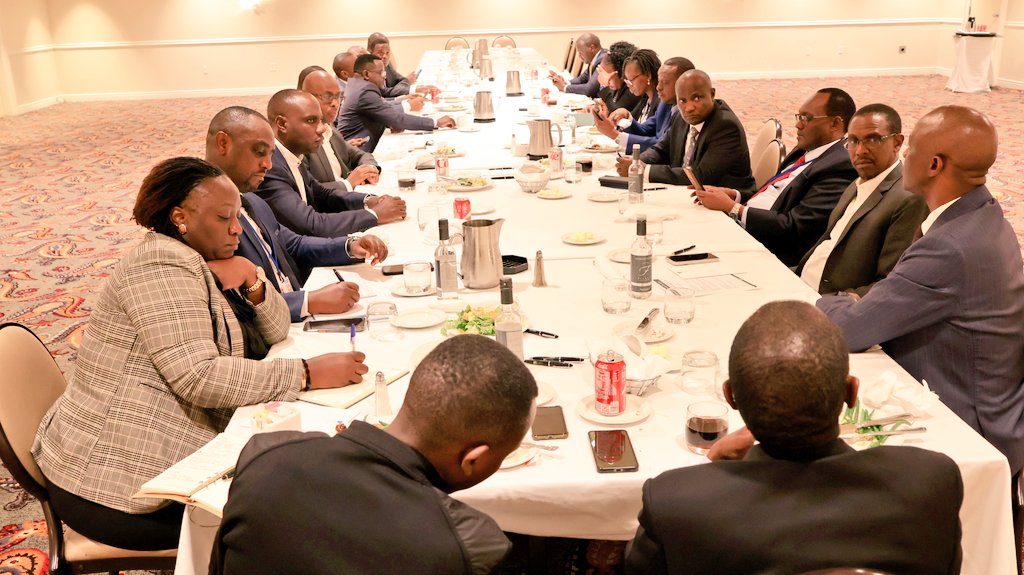
Finance ministers from East Africa have reaffirmed their commitment to fast-track the long-awaited Standard Gauge Railway (SGR) project, positioning it as a cornerstone for regional integration and trade competitiveness.
The high-level meeting, held on the sidelines of the 2026 Spring Meetings of the International Monetary Fund and the World Bank, brought together John Mbadi of Kenya, Yusuf Murangwa, and Uganda’s Minister of State for Finance Henry Musasizi.
Senior officials, including Uganda’s Attorney General Kiryowa Kiwanuka and Permanent Secretary and Secretary to the Treasury Ramathan Ggoobi, also attended, alongside counterparts from Kenya and Rwanda.
Regional Commitment Strengthens
Kenya reaffirmed its leadership role in extending the SGR to the Ugandan border at Malaba. Mbadi emphasized the need for coordinated action among partner states to ensure the project’s viability.
“There is need for closer cooperation among the partner states to ensure the viability of the project,” he said.
Rwanda signaled readiness to extend the railway from Uganda into its territory. Murangwa described the SGR as a transformative infrastructure project that will deepen regional and continental connectivity.
“This is an opportunity to connect the region and Africa, to reap the benefits of interconnectivity in terms of trade and investment,” he said, while commending Kenya and Uganda for taking the lead.
Uganda Pushes Ahead
On Uganda’s side, Musasizi confirmed that implementation is already underway, with the line set to connect Malaba to Kampala.
“The viability of this SGR depends on all of us committing to do the project,” he said, adding that Uganda plans to extend the railway to Rwanda and the Democratic Republic of Congo.
Ggoobi revealed that Uganda has already contracted the construction of the 270-kilometre Malaba–Kampala section and appointed Citibank as lead arranger and coordinator for project financing.
He noted progress in acquiring the right of way and ongoing discussions with the World Bank to support the project.
Financing Talks Advance
Earlier, the Ugandan delegation held separate talks with a World Bank team led by Qimiao Fan, focusing on potential financing options for the railway.
The World Bank signaled willingness to support the project, with Fan indicating the institution would consider available financing opportunities.
Ugandan officials also met representatives from Citibank, led by Managing Director Richard Hodder, to review progress in mobilising funding for the multi-billion-dollar infrastructure project.
Trade and Connectivity Gains
The SGR is expected to significantly reduce cargo transport costs, improve efficiency, and enhance trade competitiveness across East Africa. By linking landlocked countries to seaports, the railway is seen as critical to unlocking regional economic potential.
Analysts say the renewed political commitment and progress on financing mark an important step toward realising one of East Africa’s most ambitious infrastructure projects.
As discussions continue, the focus now shifts to securing full financing and ensuring coordinated implementation across borders, a key determinant of the project’s long-term success.