Uganda’s labour market tilts toward services as informality remains dominant – UBOS survey
Beyond employment numbers, the report raises concerns about the quality of jobs. A significant share of the workforce is engaged in subsistence and own-use production, particularly in agriculture. Nationally, more than half of working individuals are involved in such activities, often characterised by low productivity and limited earnings.
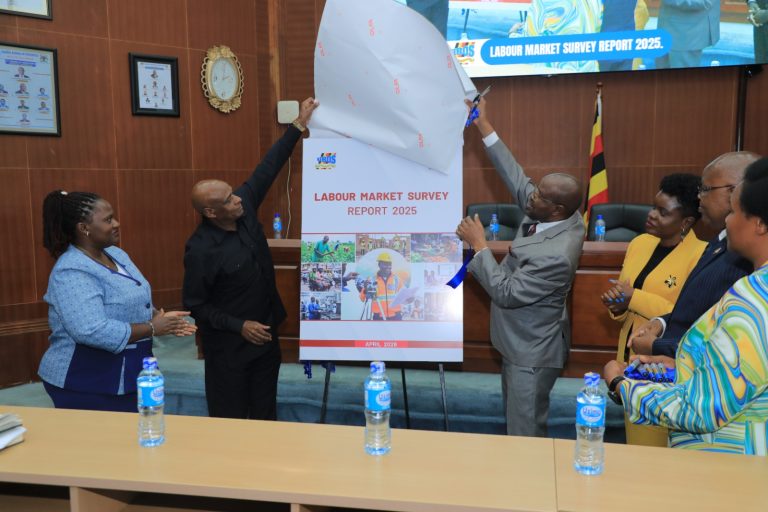
Uganda’s labour market is undergoing a structural shift, with the services sector emerging as the country’s leading employer, even as informal work continues to dominate across most regions, according to findings from the 2025 Labour Market Survey by the Uganda Bureau of Statistics.
The report paints a picture of a youthful but constrained labour force, where job creation is increasingly concentrated in low-productivity segments and where regional disparities continue to shape employment outcomes.
A growing but uneven workforce
The survey shows that 57.6 percent of Ugandans aged 14–64 fall within the working-age population, underscoring the country’s demographic advantage. However, participation in the labour force remains uneven, with males slightly more represented than females.
At the national level, the employment-to-population ratio stands at 44.7 percent for persons aged 15 years and above, reflecting a labour market where nearly half of the adult population is actively engaged in work . Yet, this engagement varies widely across regions, with Bunyoro posting the highest employment levels, while Bukedi trails behind.
This regional imbalance highlights persistent inequalities in access to jobs, infrastructure, and economic opportunities.
Services sector takes the lead
One of the most striking findings is the dominance of the services sector, which now employs 50.5 percent of the working population. The sector has become the backbone of Uganda’s labour market, absorbing more workers than agriculture and industry combined.
Women are particularly concentrated in services, accounting for 56.4 percent of employment in the sector compared to 46.3 percent of men. This reflects both expanding opportunities in trade, hospitality, and social services, as well as structural barriers that limit women’s access to higher-paying industrial jobs.
Agriculture, forestry and fishing remain the second-largest employer, engaging 37.1 percent of the workforce. Despite its decline relative to services, the sector continues to be a critical source of livelihoods, especially in rural areas. Employment in agriculture is nearly evenly distributed between men and women.
Meanwhile, the industrial sector lags significantly, employing just 12.4 percent of the population. Notably, a higher proportion of women (16.3 percent) are employed in industry compared to men (6.9 percent), suggesting a gradual diversification of female participation beyond traditional roles.
Informality still defines Uganda’s labour market
Despite sectoral shifts, informality remains the defining feature of Uganda’s employment landscape. The survey indicates that 87.6 percent of workers are engaged in informal employment outside agriculture .
The situation is even more pronounced in certain regions. Karamoja records the highest level of informal employment at 96.8 percent, followed by Kigezi (93.7 percent), Teso (93.0 percent), and Bunyoro (92.9 percent). These figures point to limited access to formal jobs, social protection, and stable incomes in these areas.
In contrast, Kampala has the lowest rate of informal employment at 73.5 percent, reflecting relatively better access to formal sector opportunities, though informality still accounts for nearly three-quarters of employment even in the রাজধান capital.
Job quality concerns persist
Beyond employment numbers, the report raises concerns about the quality of jobs. A significant share of the workforce is engaged in subsistence and own-use production, particularly in agriculture. Nationally, more than half of working individuals are involved in such activities, often characterised by low productivity and limited earnings.
Unemployment remains another challenge, with the national rate at 12.2 percent for persons aged 15 and above, and significantly higher among young people . Youth unemployment stands at 17.9 percent for those aged 15–24, highlighting the difficulties young entrants face in securing stable work.
Implications for policy
The findings underscore the urgency of transforming Uganda’s labour market from one dominated by informal and subsistence activities to a more productive and formalised system.
Experts say this will require targeted investments in industrialisation, skills development, and support for small and medium enterprises, alongside policies aimed at formalising informal businesses.
The report also points to the need for region-specific interventions, given the stark disparities in employment patterns across the country.
As Uganda continues to pursue its development agenda, the challenge will be not just to create jobs, but to ensure they are decent, productive, and inclusive, particularly for women and the country’s growing youth population.