Ethical Finance: Tamini launch positions Uganda in the global Islamic insurance market
The milestone event, held during an Iftar dinner hosted by Senior Presidential Advisor Hajjat Hadijah Namyalo, signaled more than the birth of a new company — it underscored a strategic shift toward inclusive, faith-aligned financial services in Uganda’s evolving economy.
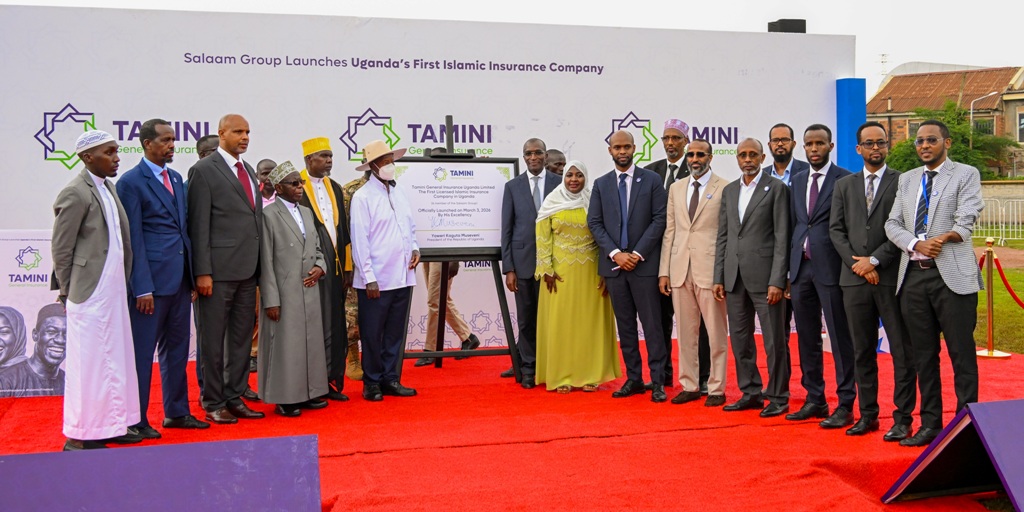
On March 2, 2025, at Millennium Park in Lugogo, Kampala, President Yoweri Museveni officially launched Tamini General Insurance, marking the entry of Uganda’s first fully-fledged Islamic insurance provider into the market.
The milestone event, held during an Iftar dinner hosted by Senior Presidential Advisor Hajjat Hadijah Namyalo, signaled more than the birth of a new company — it underscored a strategic shift toward inclusive, faith-aligned financial services in Uganda’s evolving economy.
Tamini General Insurance is a subsidiary of the Salaam Group, positioning itself as a Sharia-compliant alternative within Uganda’s growing insurance sector. Its model is built on mutual guarantees, ethical investment principles and collective participation, an approach designed to eliminate interest-based transactions while promoting shared risk and shared benefit between insurer and insured.
Completing the Financial Cycle
President Museveni welcomed Salaam Group to what he described as a market entering a demographic and economic sweet spot. With Uganda’s population now above 45 million and projected to double by 2050, he framed the launch as timely.
“Insurance is about preparing so that in case anything goes wrong, you have backup,” the President said, emphasizing that access to financing must be matched with risk protection. In that sense, Tamini’s entry complements Salaam Bank’s Islamic financing model, creating what he described as a complete financial ecosystem.
The integration is strategic. A farmer accessing halal financing can now insure crops under a Sharia-compliant framework. A trader receiving asset financing can similarly secure coverage aligned with religious principles. The result is a closed-loop system that encourages production while mitigating risk, a key ingredient in Uganda’s transformation from a consumption-led to a production-driven economy.
Expanding Financial Inclusion
Tamini’s Group CEO, Mohamed Bahdon, outlined three operational pillars: ethical investment, transparent oversight and collective participation. The objective is clear — expand insurance penetration among populations traditionally underserved by conventional models, particularly low- and middle-income earners.
Insurance uptake in Uganda has historically lagged behind regional peers. Yet according to the Insurance Regulatory Authority, the sector has grown to surpass Shs2 trillion in gross written premiums. Alhaji Ibrahim Kaddunabbi Lubega, CEO of the IRA, noted that the addition of Sharia-based insurance introduces fresh momentum into an already expanding market.
Globally, Islamic insurance, often referred to as Takaful, is valued at approximately USD 36.6 billion and projected to exceed USD 75 billion by 2033. Uganda’s entry into this ecosystem not only broadens domestic options but also positions the country to attract regional Islamic finance flows.
Policy Alignment and Poverty Eradication
The launch also intersected with the government’s broader wealth creation agenda. President Museveni reiterated support for interest-free initiatives under the Parish Development Model (PDM), clarifying that the six percent annual charge attached to PDM funds is designed purely as an inflation-control mechanism.
He urged the Muslim community, and Ugandans broadly, to channel resources toward commercially viable investments rather than consumptive expenditure. “We should work to eliminate poverty by getting everyone out of poverty,” he said, highlighting that roughly 30 percent of Ugandans remain outside the money economy.
In a notable policy remark, the President advocated for a matrilineal approach in selecting PDM beneficiaries. By prioritizing kinship through the female line, he argued, the program can better reach women-led and polygamous households that might otherwise be excluded under traditional patrilineal frameworks.
The President further pledged to scale funding support for Muslim women’s economic initiatives from Shs2 billion to Shs20 billion; reinforcing women’s role as anchors of household economic stability.
Reaching the Informal Economy
Hajjat Namyalo emphasized that Tamini General Insurance intends to focus deliberately on Uganda’s informal sector, market vendors, small-scale traders and communities vulnerable to disasters. This demographic focus is critical in a country where the majority of economic activity operates outside formal corporate structures.
Islamic insurance’s cooperative model may resonate strongly in these segments, where community-based risk sharing is culturally familiar. By lowering entry barriers and designing affordable products, Tamini aims to cultivate trust in a sector that many informal operators have traditionally viewed as inaccessible or overly complex.
Beyond Commerce: Symbolism and Unity
The evening also carried social and political symbolism. Religious leaders, including Sheikh Muhammad Yunus Kamoga, publicly commended the President for fostering interfaith unity and supporting the establishment of Muslim education and financial institutions.
While the launch was fundamentally economic, it also reflected Uganda’s broader commitment to religious pluralism within its financial architecture, allowing citizens to participate in the formal economy without compromising faith principles.
A Market at an Inflection Point
Uganda’s Vision 2040 blueprint envisions a transformed, middle-income economy built on industrialization, value addition and financial deepening. Insurance, particularly agriculture and SME coverage, plays a central role in that ambition.
Tamini General Insurance’s entry represents more than diversification; it signals the normalization of ethical and alternative finance within mainstream economic planning. By aligning faith-based finance with national development priorities, Uganda is expanding the boundaries of inclusion.
For Salaam Group, the message from State House was clear: the timing is right. For Uganda’s insurance industry, the arrival of Sharia-compliant coverage introduces competition, innovation and access. And for thousands of small producers, traders and entrepreneurs, it offers something more foundational — protection.
In a country betting on production and inclusive growth, risk management may prove to be the quiet catalyst that sustains transformation.