More Than Medicine: Ggoobi recasts health spending as investment driving Uganda’s economic growth
At the core of his message was a call to elevate health spending into the same category as growth-driving investments. He argued that healthier populations translate into stronger human capital — a key pillar for sustained economic transformation.
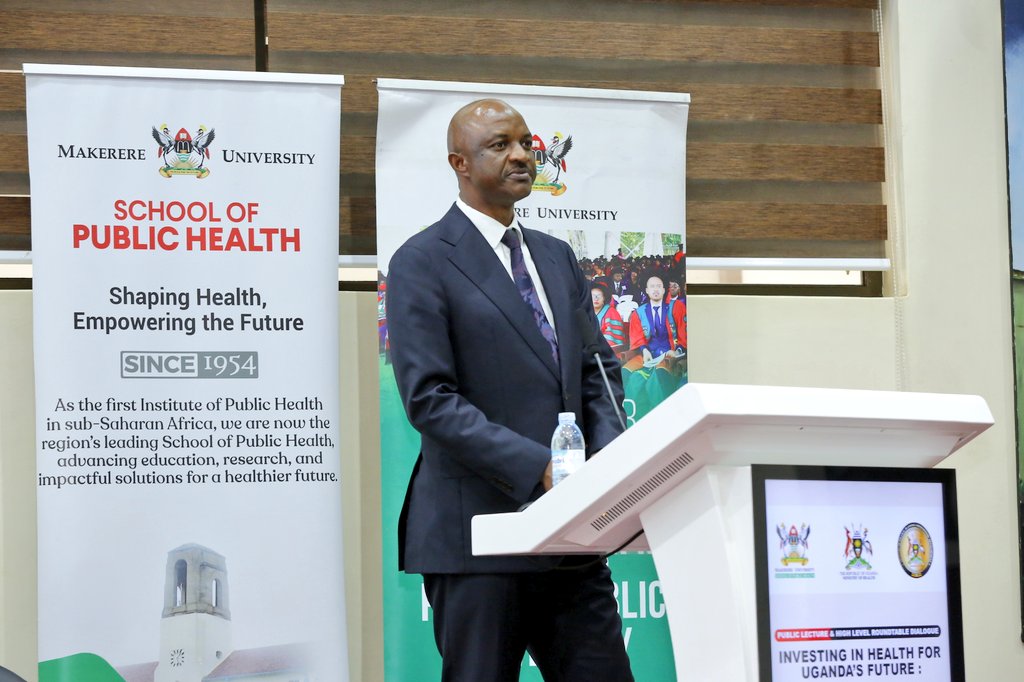
Uganda’s long-term economic ambitions will depend as much on hospitals and prevention as they do on roads and industry, Ramathan Ggoobi said in a wide-ranging keynote that challenged policymakers to rethink how the country finances health.
Delivering a public lecture at the Makerere University School of Public Health, Ggoobi positioned health financing at the centre of Uganda’s push toward middle-income status under Vision 2040, arguing that spending on healthcare should be treated as a strategic investment rather than a recurring cost.
“Every shilling must buy measurable economic and social returns,” he said, underscoring the link between a healthy population and productivity, workforce stability, and national competitiveness.
From Cost to Capital
In his address themed “Investing in Health for Uganda’s Future: Delivering Vision 2040 through Smart and Sustainable Health Financing,” Ggoobi laid out a five-point framework that blends fiscal discipline with social protection.
At the core of his message was a call to elevate health spending into the same category as growth-driving investments. He argued that healthier populations translate into stronger human capital — a key pillar for sustained economic transformation.
This approach marks a shift in policy thinking, particularly in a country where health budgets have often been vulnerable to cuts and competing fiscal pressures.
Reducing Donor Dependence
While acknowledging the role of development partners, Ggoobi warned that external aid cannot provide a stable foundation for Uganda’s healthcare system. He instead called for predictable, pooled domestic financing to shield households from catastrophic health expenditures.
Uganda continues to rely heavily on donor funding, while out-of-pocket payments remain high — a combination that exposes families to financial shocks and limits equitable access to care.
To address this, Ggoobi said government will progressively increase domestic health allocations and protect them from in-year budget cuts and cash-flow disruptions. He also pointed to the need for innovative financing mechanisms, including institutional investments and a national health insurance scheme.
Efficiency Before Expansion
In a message likely to resonate with budget planners, Ggoobi cautioned against simply increasing funding without addressing inefficiencies.
“Finance smarter before financing more,” he said, noting that better procurement systems, strategic purchasing, and reduced wastage could unlock significant resources within the existing envelope.
This efficiency-driven approach, he argued, would free up funds to expand coverage and strengthen financial protection without placing excessive strain on public finances.
Evidence Meets Policy
Ggoobi also called for a closer partnership between the Ministry of Finance and academia, particularly the Makerere University School of Public Health, emphasizing that research must be framed in fiscal and economic terms to influence policy decisions.
“Evidence framed in fiscal terms drives policy,” he said, highlighting the need for data that clearly demonstrates returns on health investments.
Prevention and Integration
Looking ahead, Ggoobi advocated a shift toward preventive care and more integrated health systems as Uganda seeks to maximise impact from limited resources. Reducing reliance on donor funding, he added, will require both structural reforms and sustained political commitment.
Despite progress in expanding healthcare access, improving life expectancy, and strengthening infrastructure, he noted that systemic challenges — including inefficiencies and funding gaps — continue to constrain outcomes.
Health as the Foundation of Wealth
Ggoobi concluded with a broader reflection on Uganda’s development trajectory, arguing that economic growth cannot be sustained without deliberate investment in human capital.
“Healthy populations build wealthy nations,” he said, framing healthcare not just as a social service, but as the backbone of Uganda’s future prosperity.
As policymakers, researchers, and private sector actors converge on financing reforms, the message from the lecture was clear: Uganda’s path to Vision 2040 will be shaped not only by how much it spends on health, but how wisely it invests.