Museveni challenges colonial-era Nile agreements with Egyptians, calls for modern solutions
“I have been discussing this with Egyptian leaders for a long time. They always talk about the old agreements with the British, but I tell them that the problem of the Nile is not those agreements,” he said.
President Yoweri Kaguta Museveni has called for a strategic and ideological rethinking of how countries address challenges facing the Nile Basin, emphasizing that Africa’s long-term survival hinges on electrification, industrialization and regional integration.
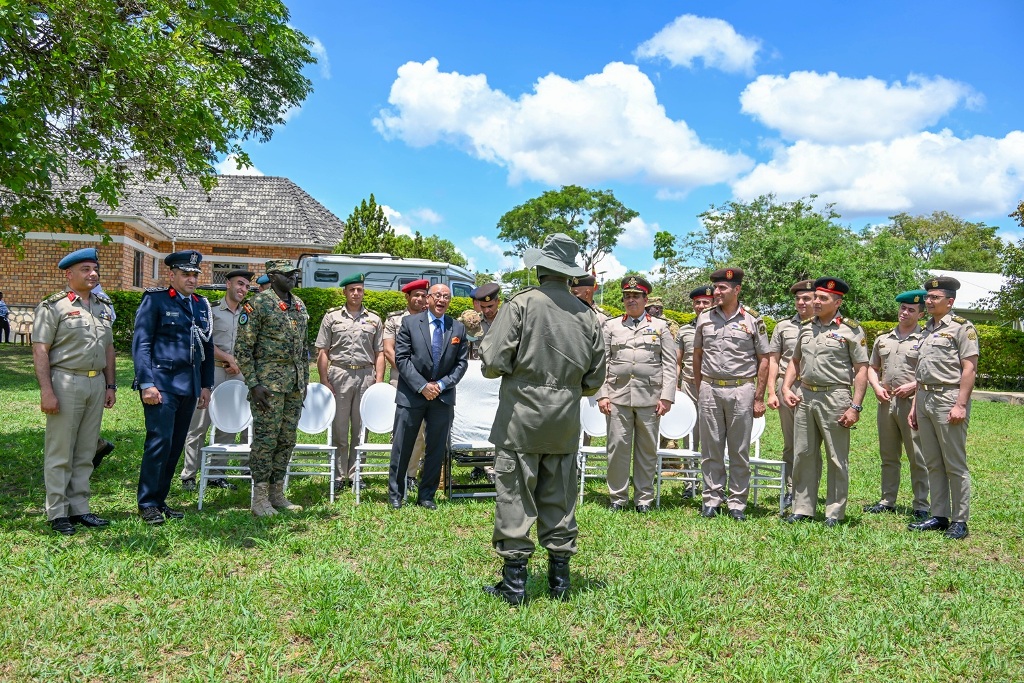
The President made the remarks while delivering a lecture of opportunity to a delegation from the Egyptian Armed Forces Staff and Command College at the National Leadership Institute Kyankwanzi.
The delegation, led by Egypt’s Ambassador to Uganda Monzer Selim and Khaled Elnahraway, engaged in discussions focused on regional cooperation, security and sustainable management of the Nile Basin.
In his address, President Museveni cautioned against overreliance on colonial-era agreements in discussions about the Nile, arguing that such frameworks fail to address contemporary challenges.
“I have been discussing this with Egyptian leaders for a long time. They always talk about the old agreements with the British, but I tell them that the problem of the Nile is not those agreements,” he said.
Instead, the President identified underdevelopment in tropical countries as the primary threat to the river, particularly citing lack of electricity and limited industrialization.
“The problem of the Nile, number one, is the lack of electricity in the tropics. When people don’t have electricity, they depend on biomass, and that is the real danger,” he noted.
He explained that reliance on biomass and subsistence agriculture is accelerating environmental degradation, including encroachment on forests and wetlands. Industrialization, he argued, would reduce pressure on natural resources by shifting populations away from low-productivity agriculture.
President Museveni also pointed to global climate change, driven largely by emissions from industrialized nations, as an added strain on the Nile Basin.
Calling for a forward-looking solution, he proposed the development of a comprehensive master plan for the Nile Basin anchored on electrification and industrial growth.
“I always tell them, let us have a master plan for transforming the Nile Valley through electrification and industrialization,” he said.
The President further revealed that water flow from Uganda into South Sudan has declined significantly over the decades, dropping from about 60 billion cubic metres in the 1960s to approximately 40 billion cubic metres today, largely due to reduced rainfall.
Drawing comparisons with the Congo River, he highlighted the untapped potential for regional cooperation in water resource management.
“The Nile has about 85 billion cubic metres of water at Khartoum, but the Congo River has about 3,000 billion cubic metres. The Congo can provide the equivalent of about 30 Niles if there is peace and cooperation,” he explained.
Beyond environmental concerns, President Museveni framed the Nile question within Africa’s broader historical mission of achieving prosperity, strategic security and continental unity.
“Prosperity does not come from begging. It comes from producing goods and services, selling them, and accessing markets,” he said, underscoring the need for economic self-reliance.
He emphasized that patriotism and Pan-Africanism are essential for sustainable growth, noting that while national development is important, regional integration is critical for global competitiveness.
“Even if Uganda becomes a first-class country, it is too small. Integration gives us size and strength,” he said.
On security, the President stressed the importance of collective strength, particularly in a global environment where technological and military capabilities are rapidly evolving.
He also highlighted the need to protect key natural ecosystems, including water towers such as the Rwenzori Mountains, Mount Kenya and Mount Elgon, which play a crucial role in sustaining rainfall patterns across the region.
“The problem is not water in Africa; it is ideological. Africa’s solutions are known, but people are not focusing on the right issues,” he added.
Speaking on behalf of the delegation, Maj. Gen. Khaled Elnahraway commended Uganda for its hospitality and praised the insights shared during the visit.
“We are honoured to meet Your Excellency and to visit one of the leading training institutions in Uganda. What we have seen is far beyond what we knew from the media,” he said.
He noted that the delegation visited Jinja, home to the source of the Nile, describing it as a vital resource for both Uganda and Egypt, and expressed optimism about strengthening bilateral and regional cooperation.
The visit underscores growing diplomatic engagement between Uganda and Egypt, particularly on issues of shared strategic interest, including water resources, regional security and economic integration.