Museveni pushes for deeper East African integration to avoid “mis-cooking” Africa’s revolution
Museveni’s remarks come at a time when the East African Community is expanding rapidly, with countries such as the Democratic Republic of the Congo and Somalia joining the bloc in recent years.
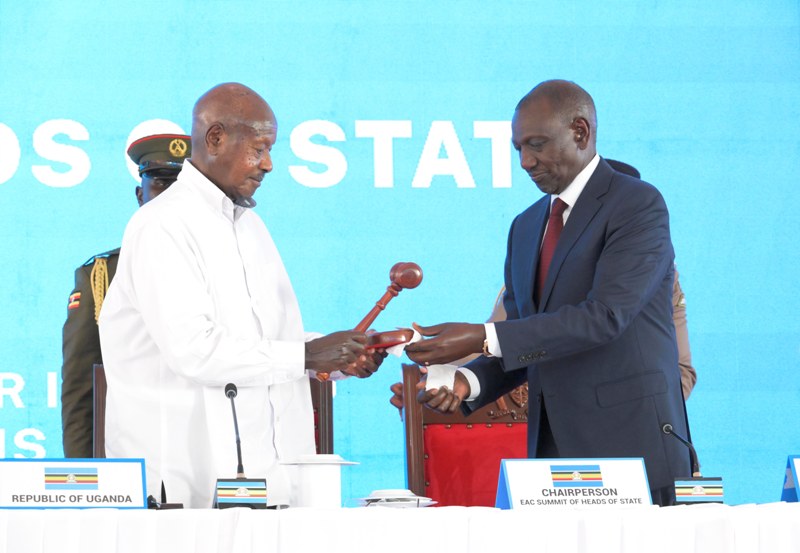
At the 25th Ordinary Meeting of the East African Community (EAC) Heads of State in Arusha, Tanzania, Uganda’s President, Yoweri Kaguta Museveni delivered a sweeping historical and ideological argument for deeper African unity, warning that the continent risks “mis-cooking” its own revolution if it fails to integrate economically and politically.
Museveni, who assumed the chairmanship of the East African Community (EAC), used the metaphor of a poorly cooked meal, drawn from a local concept he called “okukonesa”, to describe what he sees as Africa’s repeated failure to fully realize the goals of independence. According to the Ugandan leader, the continent achieved political liberation from colonial rule but has stalled on the crucial stages of economic transformation, regional integration, and strategic security.
The unfinished African revolution
Museveni framed Africa’s modern challenges within a long historical narrative stretching from the era of colonial conquest to present-day globalization. He argued that Africa’s colonization by the early 20th century was partly the result of internal weaknesses among African kingdoms, including disunity and failure to adopt technological innovations such as gunpowder.
However, he noted that African resistance eventually emerged through Pan-African movements and liberation struggles, citing historical figures such as W. E. B. Du Bois and Marcus Garvey, whose ideas inspired anti-colonial activism across the continent and diaspora.
By the 1960s, independence movements had largely succeeded in dismantling colonial rule. But Museveni argued that independence alone was never the final objective. Instead, he said, Africa’s historical mission involved four stages: liberation, modernization, prosperity, and strategic security.
According to him, the continent has only partially achieved the first.
Economic integration as the missing link
A central theme of Museveni’s address was the need for larger markets to support African production. He argued that prosperity depends on the ability of producers to sell goods and services to large numbers of consumers.
In this context, he presented regional economic integration as the most practical solution. The EAC, alongside continental frameworks such as the African Continental Free Trade Area and Common Market for Eastern and Southern Africa (COMESA), was described as a crucial step toward building the market size needed for industrialization.
Museveni suggested that fragmented national economies limit investment and job creation. When markets remain small, he said, businesses cannot scale production, which in turn reduces employment opportunities and tax revenues.
This economic argument reflects a long-standing position by the Ugandan president that regional blocs should eventually evolve into larger federations capable of competing globally.
Security through political federation
Beyond economics, Museveni emphasized that political integration is essential for strategic security. He argued that regional federations would allow African countries to pool resources and develop comprehensive defense capabilities across land, air, sea, and even space.
His remarks placed Africa’s geopolitical ambitions within a broader global context, noting that only a handful of major powers—such as the United States, China, Russia, and India—have achieved advanced technological and strategic capabilities like lunar exploration.
For Museveni, this underscores the importance of size and unity in building global influence.
Lessons from global economic powers
Museveni also compared Africa’s economic trajectory with that of Asian economies. He pointed to the rapid growth of China since economic reforms began in 1978 and India’s expansion after liberalization in 1991 as examples of how large markets attract investment and accelerate development.
According to his analysis, Africa’s combined GDP remains relatively small compared with major global economies, partly because the continent has yet to fully integrate its markets.
This argument aligns with broader debates among African policymakers about whether continental initiatives like the African Continental Free Trade Area can unlock the continent’s economic potential.
A call to Africa’s youth
Toward the end of his speech, Museveni directed his message to younger generations across Africa, urging them to revive the ideals of “Uhuru na Umoja”—freedom and unity.
He warned that the current situation in many African countries reflects “Uhuru na Uhasama”—freedom accompanied by division—resulting in economic stagnation and youth migration to Europe in search of opportunity.
By invoking past Pan-African leaders such as Julius Nyerere and Kwame Nkrumah, Museveni framed his appeal as part of a longer ideological struggle for continental unity.
The broader significance
Museveni’s remarks come at a time when the East African Community is expanding rapidly, with countries such as the Democratic Republic of the Congo and Somalia joining the bloc in recent years.
However, the EAC continues to face persistent challenges, including trade barriers, political tensions, and slow progress toward deeper federation.
The speech therefore reflects both a vision for a more integrated Africa and a critique of the slow pace of regional cooperation.
Whether the renewed push for unity gains momentum may depend on how effectively EAC member states translate these political ideas into practical economic policies and institutional reforms.