Museveni’s 2026–2031 Manifesto: Continuity, promises, and the push for high middle-income Uganda
President Museveni expressed gratitude to the NRM delegates for once again entrusting him with leadership. He noted that the party had not only re-elected him as National Chairman for the 2025–2031 term but also nominated him as the flag bearer for the 2026 elections.
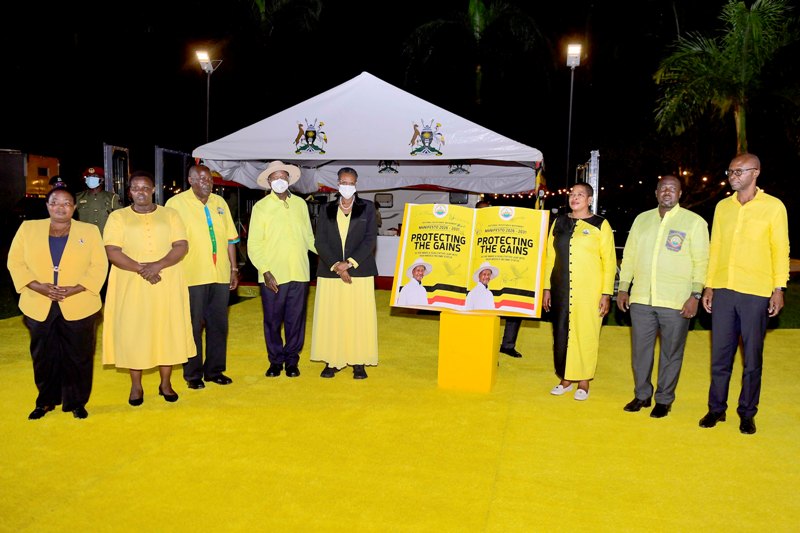
President Yoweri Kaguta Museveni on Monday 29th September launched the National Resistance Movement (NRM) manifesto for 2026–2031, promising Ugandans a path toward stability, wealth creation, and eventual transition into high middle-income status.
The document, unveiled under the theme “Protecting the Gains and Securing a Qualitative Leap into High Middle-Income Status,” underscores the NRM’s argument that sustained peace and security, paired with deeper economic transformation, remain the foundation of Uganda’s future.
Peace, Security, and the Fight Against Crime
The manifesto positions peace and security as the NRM’s enduring legacy since 1986. Museveni credited the Uganda People’s Defence Forces (UPDF) for guaranteeing stability, but cautioned against rising crime at community level.
Theft and corruption, he argued, threaten government programs like the Parish Development Model (PDM). The promise here is tougher enforcement against petty crime, stricter accountability in the judiciary and police, and stronger community discipline.
Security remains a persuasive card for the NRM. However, critics may note that pledges to curb crime and corruption have been repeated in past manifestos, with limited results. The challenge will be in demonstrating that this time enforcement will go beyond rhetoric.
Infrastructure and Economic Growth
The manifesto pledges to expand Uganda’s economic and social infrastructure like roads, electricity, ICT, schools, and hospitals. With power generation boosted by Karuma and Isimba dams, NRM leaders argue that improved infrastructure will sustain industrial growth and regional trade.
Infrastructure expansion is a visible achievement that resonates with many voters. Yet, questions remain about whether investment is equitably distributed, and whether the debt burden tied to large projects could constrain Uganda’s fiscal space.
Wealth Creation and Jobs
Museveni emphasized commercial agriculture as the backbone of job creation. With 40 million acres of arable land, he argued that Uganda could generate more than 100 million jobs if land is fully utilized. PDM remains the flagship strategy, with increased funding—up to Shs. 300 million for Greater Kampala Metropolitan parishes—and targeted support for vulnerable groups.
The wealth creation narrative directly appeals to households stuck in subsistence farming. Still, the NRM faces skepticism over whether its programs can deliver transformative results at scale, or whether issues like corruption, land disputes, and climate change will undermine implementation.
Science, Innovation, and Health
The manifesto highlights Uganda’s scientific potential, showcasing homegrown discoveries in treating diseases such as cancer, malaria, and diabetes. Museveni positioned science as a frontier for Uganda’s contribution to the global economy.
This emphasis signals a desire to modernize Uganda’s development narrative. Yet, critics may question whether research funding and institutional support are adequate to sustain such ambitious claims.
Education and Human Capital
The NRM promises education reforms designed to produce job creators. This includes recruiting 49,406 new teachers, enhancing civil service salaries, and reforming the curriculum. UPE and USE will remain pillars, but with stronger attention to quality.
Education pledges appeal to a youthful population but face the test of credibility, given long-standing challenges of underfunding, teacher absenteeism, and poor learning outcomes.
Governance and Accountability
On governance, the manifesto promises zero tolerance for corruption, decentralization reforms, and improved land administration. These commitments are framed as necessary for equitable development.
The message is familiar—anti-corruption has been a recurring promise in every NRM manifesto. Whether new approaches will overcome entrenched patronage networks remains uncertain.
Regional Integration
NRM promises to push for East African federation, a single currency, and removal of trade barriers. This regional agenda is tied to Museveni’s long-standing vision of Africa’s economic integration.
While attractive on paper, progress on East African integration has often been slow and subject to political rivalries. Uganda’s influence in shaping regional dynamics will depend on diplomacy and internal economic strength.
The Political Balance Sheet
The manifesto positions the NRM as the custodian of stability and economic progress. It points to past gains—poverty reduction, rising exports, increased power generation, and higher life expectancy—as evidence of competence. But critics are likely to see a familiar pattern: ambitious promises layered on top of unfinished business from past manifestos.
In the end, the 2026–2031 manifesto is both a development blueprint and a political statement. It seeks to reassure Ugandans that continuity under Museveni will deliver the elusive leap to middle-income status. Whether voters view these pledges as credible progress or recycled assurances will be tested in the 2026 elections.