Uganda confirms Ebola outbreak after Congolese patient dies in Kampala
An imported case from the DRC has triggered a national health response, with contact tracing under way and borders under heightened surveillance
Uganda’s Ministry of Health declared an Ebola Bundibugyo Virus Disease outbreak on Thursday 15 May 2026, after laboratory tests confirmed the disease in a 59-year-old Congolese man who died at Kibuli Muslim Hospital in Kampala four days after being admitted.
The patient was admitted on 11 May presenting with respiratory distress, episodes of fever, epigastric pain, nausea and difficulty urinating. His condition deteriorated rapidly in the Intensive Care Unit, and he died on 14 May with bleeding symptoms, a late-stage hallmark of Ebola infection. His body was repatriated to the Democratic Republic of Congo on the same evening.
The outbreak declaration came after DRC public health authorities notified Uganda of a suspected Ebola case on 15 May. The Ministry moved swiftly to test a preserved sample taken from the patient during his care, sending it to the Central Emergency Surveillance and Response Support laboratory in Wandegeya, where it returned positive for Ebola Bundibugyo, a strain distinct from the more widely known Zaire strain that caused the major West Africa and DRC outbreaks of the past decade.
“This is an imported case from the DRC. The country has not yet confirmed a local case,” the ministry of health said in a press statement on 15 may 2026
What the government is doing
Screening, surveillance and rapid response teams deployed at official and informal points of entry along the western border, major transit routes and pilgrimage corridors.
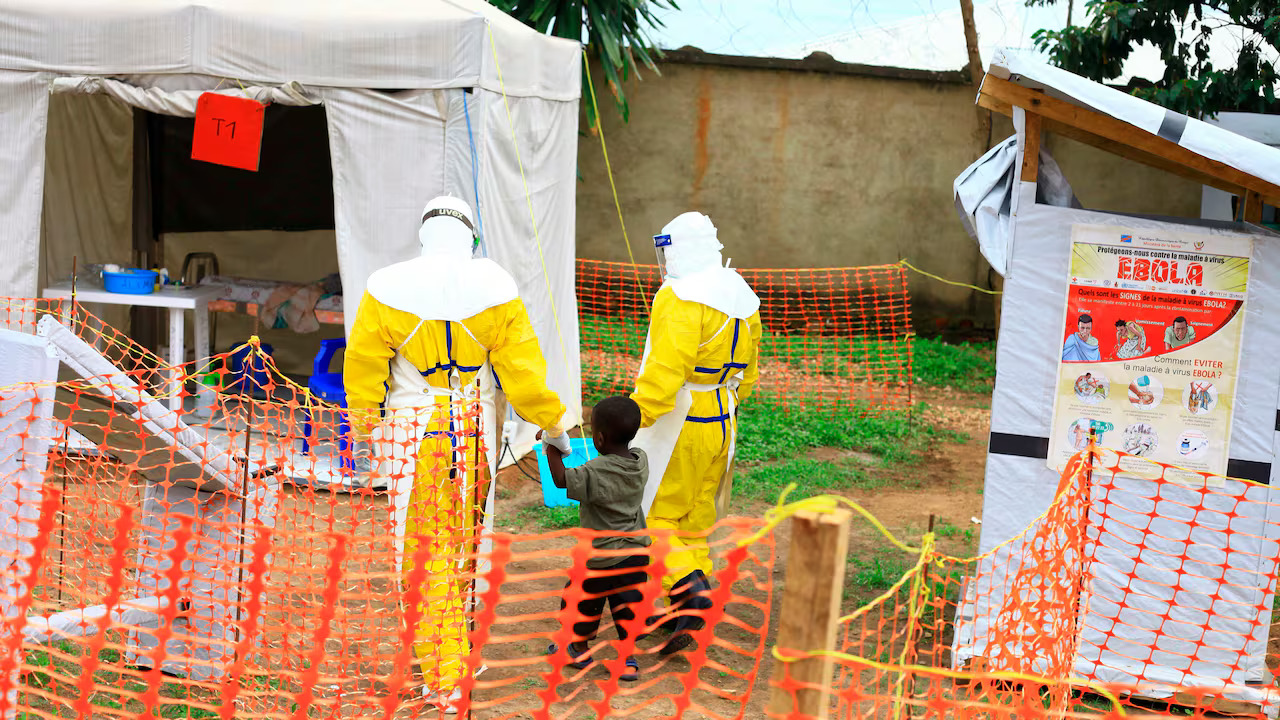
Mobile laboratory deployed to Bwera Hospital; isolation arrangements, infection prevention and control measures, and risk communication activated in high-risk districts.
One high-risk contact, a close relative of the deceased, has been isolated. All other contacts of the index case are being quarantined and monitored.
Why this strain matters
The Bundibugyo strain of Ebola was first identified in Uganda’s Bundibugyo district in 2007, where it caused an outbreak that killed 37 people. It is one of six known species of Ebolavirus and shares transmission routes with other strains: direct contact with blood, body fluids, or contaminated objects from an infected person, as well as contact with infected animals such as fruit bats, chimpanzees and gorillas. Like all Ebola strains, it is not airborne.
Symptoms, which the index case displayed across his admission, include sudden-onset fever, fatigue, chest pain, diarrhoea, vomiting and unexplained bleeding. Bleeding manifestations typically appear later in the illness, and their onset in the patient’s final hours underscores how quickly the disease can progress once established.
The cross-border dimension
The case highlights the persistent public health challenge posed by Uganda’s long and porous border with the DRC, a country that has battled repeated Ebola outbreaks, including a prolonged and deadly one in North Kivu between 2018 and 2020. Movement of people across the border for trade, family, and pilgrimage is continuous and largely informal, making it difficult to screen all arrivals.
The Ministry of Health’s decision to deploy teams specifically to “pilgrimage corridors” in its response measures suggests awareness of religious and cultural travel patterns as a particular transmission risk. Uganda’s health system has significant experience managing Ebola, it has handled multiple outbreaks since 2000, and that institutional memory is likely to shape the speed and sophistication of its contact-tracing operation in the days ahead.
The Permanent Secretary, Dr. Diana Atwine, signed the official press statement urging health workers to maintain the highest index of suspicion and to report any suspected case to district health authorities immediately. The public has been asked to avoid contact with anyone showing symptoms, maintain hand hygiene, and steer clear of body fluids. Handling of any body suspected to have died of Ebola must be supervised by a health team and conducted as a safe and dignified burial.