
Beyond Crude Export: Tanga energy hub signals new era in Uganda–Tanzania energy value chain partnership
Uganda and Tanzania are attempting to answer that question together, by building an energy corridor designed not only to move resources, but to retain more of their economic value within East Africa.
Uganda and Tanzania are moving to deepen their energy partnership beyond the East African Crude Oil Pipeline (EACOP), with a new agreement positioning the Tanzanian port city of Tanga as a regional energy and petroleum trading hub capable of reshaping the flow of energy, investment and industrial activity across East Africa.
The partnership, launched during President Yoweri Kaguta Museveni’s two-day working visit to Dar es Salaam, brings together the Uganda National Oil Company (UNOC), Tanzania Petroleum Development Corporation (TPDC) and Vitol Bahrain E.C. to jointly develop the Tanga Regional Energy Hub.
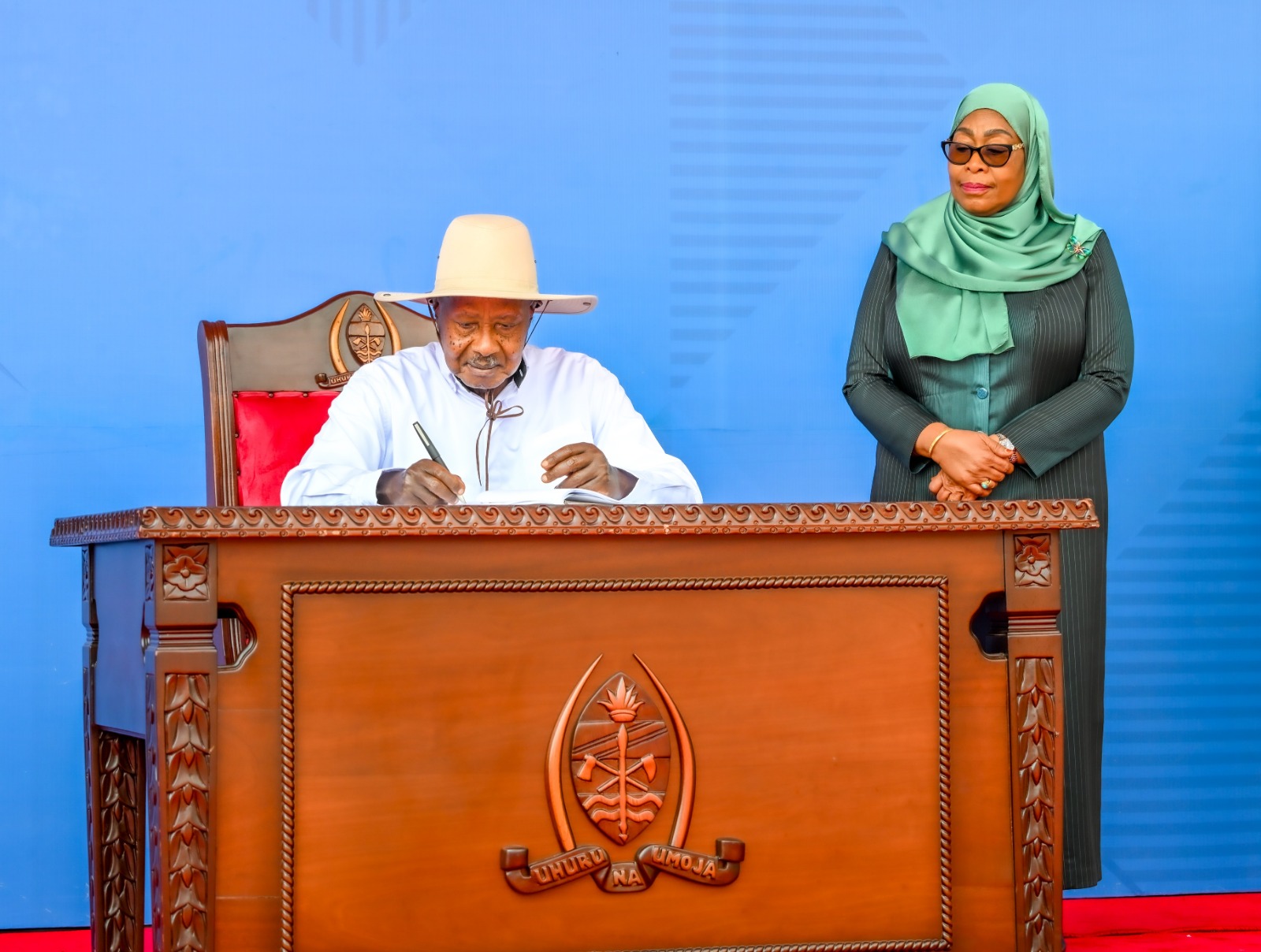
The agreement, witnessed by President Museveni and Tanzanian President Dr. Samia Suluhu Hassan at State House in Dar es Salaam, marks an important shift in the two countries’ petroleum relationship – from building infrastructure to creating a broader regional energy value chain.
The proposed hub is expected to integrate petroleum storage, refining, logistics, trading and distribution, complementing Uganda’s emerging oil industry and its planned Hoima refinery while strengthening Tanzania’s role as a strategic energy gateway for the region.
For Uganda, the commercial logic is significant. The country is preparing to enter oil production while simultaneously seeking to build industries around its petroleum resources rather than remain primarily an exporter of crude.
Uganda’s Energy and Mineral Development Minister, Dr. Monica Musenero, said the partnership should be viewed as part of a wider industrialisation strategy.
“These are not merely infrastructure projects. They are strategic investments that will create jobs for our young people, deepen regional trade and strengthen the logistics systems that support our economies,” Musenero said.
She said Uganda wants to extract greater economic value from its petroleum resources through secondary and tertiary industries, including engineering, operations, maintenance, laboratory services and management.
The emerging energy corridor will extend beyond crude oil. Feasibility and front-end engineering design studies for a proposed refined petroleum products pipeline and storage terminal are progressing, with completion expected later this year.
At the same time, feasibility studies for a proposed natural gas pipeline connecting Uganda and Tanzania are at an advanced stage and are expected to be completed by October 2026.
From EACOP to a regional energy market
The Tanga hub builds on the infrastructure and commercial relationships created by EACOP, which is expected to transport Uganda’s crude oil to the Tanzanian coast for export.
Tanzania’s Energy Minister, Deo Ndejembi, described the new development as the next phase of the bilateral energy partnership.
“EACOP transports molecules. The Tanga Regional Energy Hub transforms those molecules into prosperity,” Ndejembi said.
He said the proposed hub could attract more than US$20 billion in investment, potentially making it one of the largest integrated energy infrastructure developments in Sub-Saharan Africa.
The ambition is to create an ecosystem in which petroleum is not simply moved through Tanzania but stored, processed, traded and distributed through a network serving multiple regional markets.
This could open new opportunities for Uganda’s petroleum products while improving energy security across East Africa.
Ndejembi said Uganda’s planned 60,000-barrel-per-day Hoima refinery should not be viewed as competing with the Tanga hub.
Instead, he said the two projects could operate as complementary components of a regional petroleum system, with a proposed bidirectional multi-product pipeline allowing refined products to move between Uganda and Tanzania according to market demand.
For Uganda, that flexibility could become increasingly important as domestic refining capacity comes on stream and the country seeks markets beyond its borders.
Electricity adds another layer
The energy partnership is also expanding into electricity.
Uganda is pursuing a 400kV electricity interconnector with Tanzania, with Musenero saying negotiations with the World Bank were concluded in March before Uganda secured US$250 million in financing in June for its section of the project.
The interconnector is expected to increase electricity exchanges between the two countries, strengthen the Eastern Africa Power Pool and potentially create new opportunities for electricity trade with markets in Southern Africa.
Taken together, the petroleum, gas and electricity projects point to an increasingly integrated energy relationship between Uganda and Tanzania.
For investors, that integration could be as important as the individual projects themselves.
EACOP demonstrated that the two countries can collaborate on complex cross-border infrastructure. The new Tanga agreement seeks to leverage that experience into a much larger proposition: an interconnected regional energy market supported by pipelines, ports, storage facilities, refineries, power transmission and trading infrastructure.
The broader economic prize is industrialisation.
Both countries are seeking to convert energy infrastructure into jobs, logistics businesses, manufacturing opportunities and new investment.
As Ndejembi put it, the partnership is no longer about asking what comes after EACOP.
Uganda and Tanzania are attempting to answer that question together, by building an energy corridor designed not only to move resources, but to retain more of their economic value within East Africa.