
Govt to explore enzyme technology that turns local soil into road and housing material
Indian investor pitches soil-stabilising enzyme as a way to cut construction costs, but government insists on independent local trials first
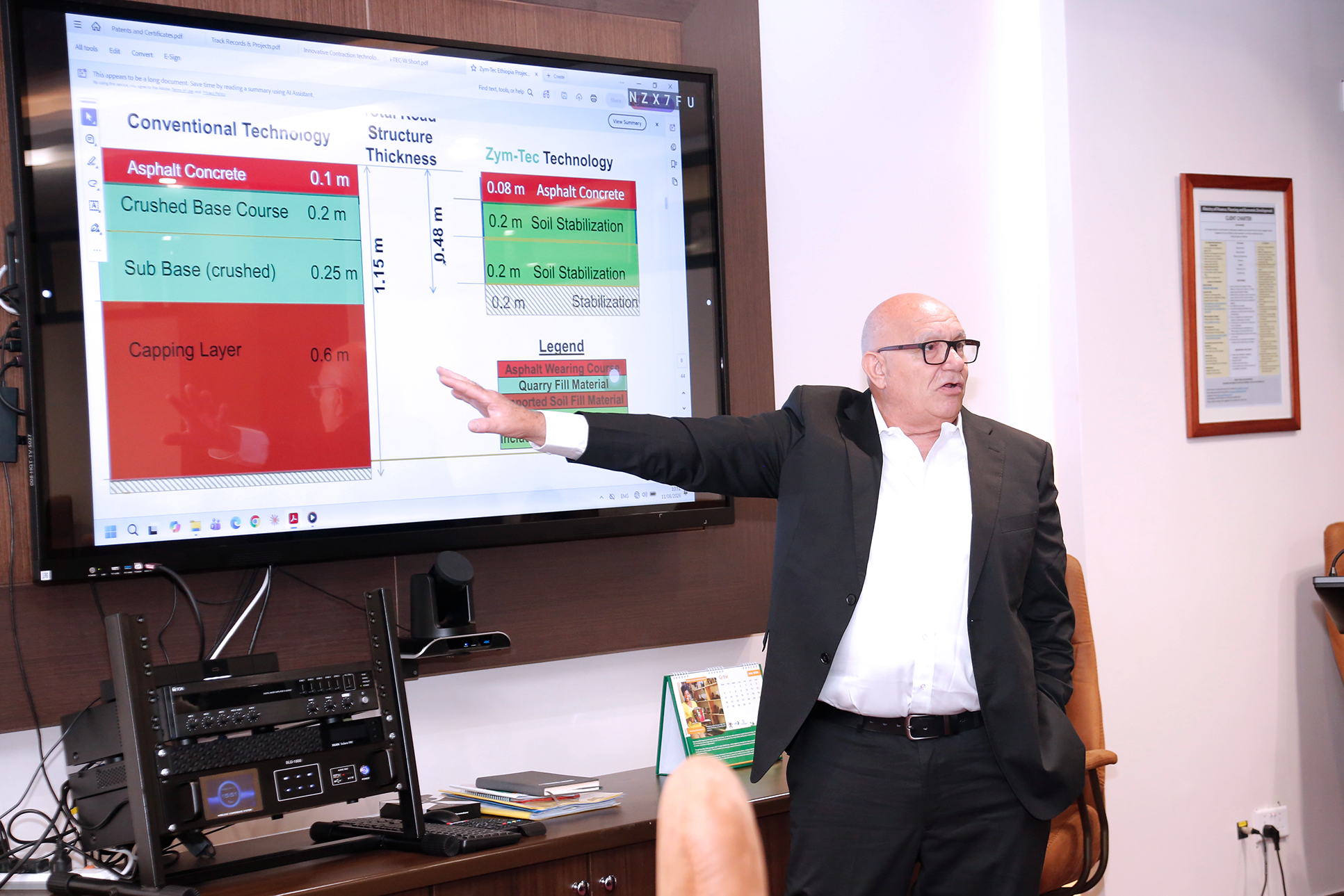
The State Minister for Finance (Planning), Hon. Amos Lugoloobi, together with National Planning Authority Chairperson Prof. Pamela Mbabazi, has welcomed Yosef Atoon, CEO and Founder of I-TEC-WIZYMTEC Technologies Ltd, an investor from India, to explore an innovative technology that could reduce the cost of building roads and houses in Uganda.
Turning ordinary soil into construction material
At the centre of the pitch is a specialised enzyme that strengthens soil already available at a construction site, transforming it into a material suitable for road bases and housing foundations.
Instead of trucking in gravel, murram or other conventional materials from distant quarries, the enzyme is mixed into the soil found on-site, chemically altering its structure so it compacts into a harder, more durable base.
Backers of the technology say it can significantly cut both construction costs and timelines by minimising the need to transport or import materials, while boosting the use of local resources and saving foreign exchange that would otherwise go toward imported construction inputs.
The approach mirrors similar enzyme-based soil stabilisers already used in road projects across parts of Asia and Latin America, which are typically applied without heavy specialised machinery and can, in some cases, allow existing road materials to be recycled on-site rather than replaced.
Government wants proof before rollout
Lugoloobi welcomed the technology’s potential but was firm that any adoption would have to rest on independent technical validation rather than immediate large-scale deployment.
He said the National Planning Authority, working with relevant stakeholders, would assess how the enzyme performs under Uganda’s specific soil and climate conditions, alongside its cost-effectiveness, compliance with engineering standards, environmental impact, scalability, local content and the extent of technology transfer to Ugandan engineers and firms.
The caution reflects a wider pattern in enzyme-based soil stabilisation: performance varies significantly depending on soil type, the correct enzyme dosage and weeks of curing time needed to reach full strength, meaning results achieved elsewhere do not automatically transfer to a new environment.
Field trials are generally considered essential before such technologies are deployed at scale.
A fit with NDP IV, NPA says
Prof. Mbabazi welcomed the innovation, noting that efforts to lower infrastructure development costs align with Uganda’s broader development vision as set out in the Fourth National Development Plan (NDP IV), and described such cost-cutting technologies as desirable for easing government’s growing infrastructure bill.
She encouraged the investor to continue engaging relevant stakeholders for technical assessment, adding that, subject to satisfactory results, pilot projects could be undertaken to generate Uganda-specific evidence before any wider deployment across the country’s road and housing programmes.