Government, Church of Uganda partner to boost fish farming and restore Wetlands
The partnership agreement will see fish feed processing machines hosted and operated on Church of Uganda premises across 24 districts in Eastern and Southwestern Uganda.
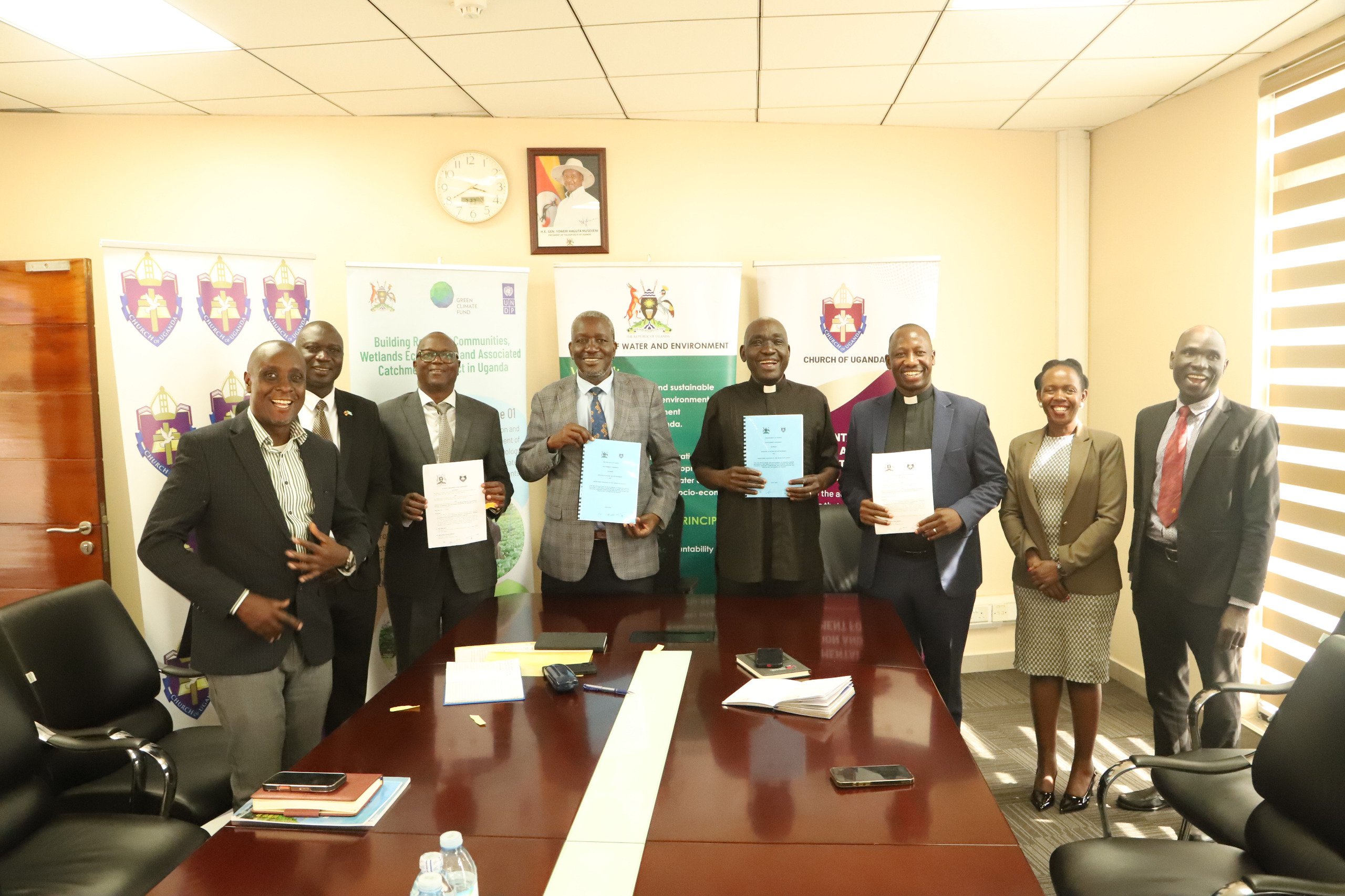
The Ministry of Water and Environment has partnered with the Church of Uganda to promote fish farming and improve livelihoods of communities previously dependent on wetland activities.
The partnership agreement will see fish feed processing machines hosted and operated on Church of Uganda premises across 24 districts in Eastern and Southwestern Uganda.
The beneficiary districts include Mbale, Tororo, Budaka, Kaliro, Namutumba, Butebo, Kumi, Butaleja, Kibuku, Pallisa, Ngora, Bukedea, Rubanda, Kisoro, Rukiga, Rukungiri, Ntungamo, Kabale, Sheema, Mitooma, Rubirizi, Kanungu, Bushenyi and Buhweju.
The agreement was signed on Thursday at the Ministry headquarters in Luzira, Kampala, under the “Building Resilient Communities, Wetland Ecosystems, and Associated Catchments in Uganda” project.
The initiative, spearheaded by the Department of Wetlands Management, aims to promote sustainable resource use, increase household incomes and provide alternative livelihoods for former wetland encroachers.
Speaking during the signing ceremony, Ministry Permanent Secretary Dr. Alfred Okidi said the project addresses one of the biggest challenges facing Uganda’s aquaculture sector — the high cost and limited access to quality fish feeds.
“Access to affordable fish feeds was still a challenge to fish farmers and was hindering the expansion of fish farming as a sustainable wetland alternative,” Okidi said.
He urged the Church of Uganda and local communities to operate the feed mills as commercial enterprises to generate income and support economic transformation.
The partnership is funded by the Green Climate Fund (GCF), United Nations Development Programme (UNDP), and the Government of Uganda, and has already recorded progress in wetland restoration and livelihood support.
According to project officials, 55,132 hectares of degraded wetlands have been demarcated and restored, while 4,009 hectares of associated catchment areas have also been restored. More than 59,000 people from 14,071 households have received alternative livelihood support through activities such as fish farming, poultry, beekeeping and livestock rearing.
GCF National Project Coordinator Tom Obong Okello said a joint asset management committee comprising representatives from the Church of Uganda, district local governments and farmers’ cooperatives had been established to oversee the project.
He added that the partnership has a 12-year framework, with responsibilities clearly defined among stakeholders and proceeds from the ventures shared fairly.
The Church of Uganda welcomed the partnership, with its Provincial Secretary Rev. Canon William Ongeng saying the initiative would encourage communities to embrace fish farming while protecting the environment.
“These machines will encourage our people to view fish farming as an effective way to preserve the environment,” Canon Ongeng said.
The Ministry said the project will continue supporting climate-resilient livelihoods while restoring degraded ecosystems across the country.