Editorial Opinion: It is time to stop buying cars for public servants
As the ordinary teacher, nurse, or clerk gets no car, funding their own commute from a modest salary, the more senior officers are more likely to get a free car and a mileage allowance on top.

In Milton Obote’s Uganda, government vehicles were not personalised. They belonged to the office, not the officer. A driver had to have the car back by 5.30 p.m.; if duty took him too far, he was required to park at the nearest police station and hand over the keys until the next working day. The vehicle was a tool for official work, not personal property.
Today that line has vanished. Government-plated vehicles routinely appear delivering charcoal, parked outside lodges, or loaded with shopping. The moment an office is allocated a car, it becomes, in practice, the personal property of whoever holds that chair, used to run errands and burn public fuel, so normalised that it barely raises an eyebrow.
When the Uganda Police Force presented its motor vehicle assets to Parliament, MP Karim Masaba noted that the vehicles the leadership drove to Parliament that day alone were worth over Sh. 6 billion (about US$1.6 million), from a delegation representing under 40% of the force’s administrative leadership. Extrapolated, headquarters alone may account for over sh 12 billion (about US$3.2 million), with a comparable or larger sum spent regionally and at district level.
Police is just one agency. Every Ugandan district has a chairperson, a Chief Administrative Officer, a District Security Officer, a District Health Officer, a Resident District Commissioner, and more, each entitled to a vehicle. On average, about sh 500 million (about US$133,000) per district across all 135 districts; that’s roughly 94.5 billion (about US$25.2 million). Kampala’s mayor alone reportedly drives a car valued at about 300 million (about US$80,000).
Earlier this year, a supplementary 35.2 billion (about US$9.3 million) was allocated purely for new Toyota double-cabin pickups for district chairpersons and municipal mayors. Separately, the Directorate of Public Prosecutions reportedly procured 32 vehicles off the books, worth about one billion (about US$267,000).
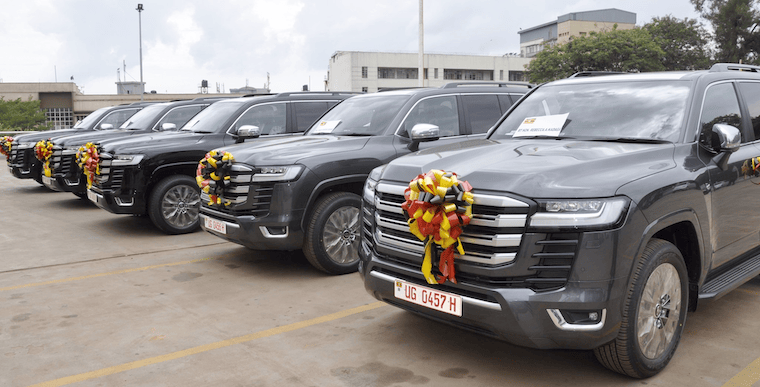
Parliament adds more: each MP receives a car grant of 315 million (about US$84,000). Across more than 500 legislators, that’s over 166 billion (about US$44.5 million), on top of separate transport or mileage allowances many also draw, effectively paying twice for the same trip.
Beyond police, districts, the DPP, and Parliament, other agencies collectively spend an estimated 300 billion (about US$80 million) equipping top officials with vehicles.
Most of these figures span a roughly five-year procurement cycle, but if all this money were turned into a soft loan for those having the vehicles and the cars become personal property, then the government will see that this money is recovered and used to plug real gaps, mostly at a time when the country struggles to pay its interns. Worse, many vehicles develop conveniently “irreparable” faults within three years, get auctioned, and are replaced – amid suspicion that some officials quietly reacquire them under other names. This is baffling because most new vehicles are under a minimum of a 5-year warranty.
Meanwhile, the unequal treatment is visible. As the ordinary teacher, nurse, or clerk gets no car, funding their own commute from a modest salary, the more senior officers are more likely to get a free car and a mileage allowance on top.
Neighbouring Rwanda faced the same problem. It recalled over a thousand official vehicles, keeping cars for only a handful of top office holders, the President, Prime Minister, and a few others. Everyone else moved to a “vehicle loan” scheme: officials buy their own cars, in their own names, via interest-free government-backed loans, plus a monthly allowance covering repayment, fuel, and maintenance. The vehicle belongs to the individual and stays with them after office, though lenders can repossess it on default.
Rwanda has since required at least 30% of new government vehicles to be electric, cutting costs and emissions. Officials report the reform sharply reduced misuse, as a car financed in your own name isn’t one you can afford to be careless with. This was a deliberate policy choice to separate personal comfort from public duty.
Uganda doesn’t need to reinvent this; let it just adapt Rwanda’s model, which is African, tested, and structurally comparable.
Limit state-owned, chauffeur-driven vehicles to a handful of top offices and security heads where protocol genuinely requires it. Everyone else moves to a loan scheme: the vehicle an official currently drives becomes their personal property, financed through a government-backed loan paired with a monthly running allowance, not both a free car and separate mileage pay.
New vehicles going forward should be brand-new hybrids under warranty with free servicing, to save users the many costs related to services where they are bound to change the vehicle’s original parts- at least up to the loan completion- which should be completed in a maximum of three years.
The government should publish the savings from this shift and where it’s being invested for transparency, as Ugandans would like to see more ambulances, rural referral transport, improved public transport, and the long-promised railway improvements.
This requires no new technology, only the political will to treat public vehicles with the respect it was during Obote’s time: an instrument of duty, logged in and handed back, not a personal inheritance that comes with the office. That is how nations develop: not by spending more, but by directing existing resources to serve the greatest number and holding the few entrusted with public resources to a standard the public can see.