
Uganda’s economy grows 6.4% as government releases Shs21.82 trillion for Q2
The latest economic figures show that the nominal value of Uganda’s economy increased to Shs250.45 trillion, equivalent to $69.345 billion, in FY 2025/26, from Shs227.87 trillion ($61.986 billion) in FY 2024/25.
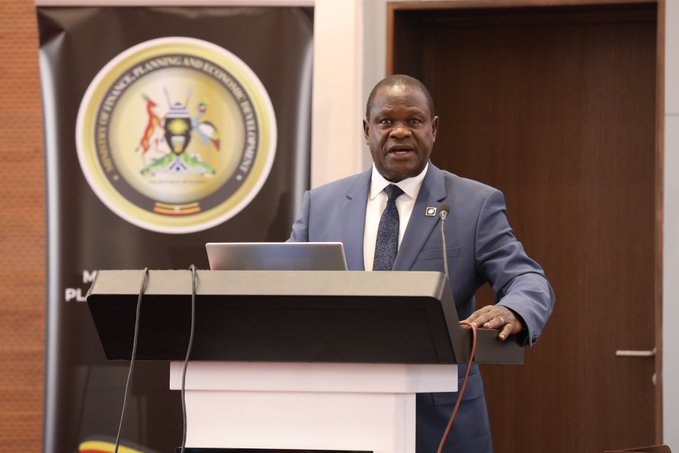
Uganda’s economy grew by 6.4 per cent in the 2025/26 financial year, up from 6.3 per cent the previous year, as government released Shs21.82 trillion to finance public services and strategic investments in the second quarter of the current financial year.
Patrick Ocailap, the acting Permanent Secretary and Secretary to the Treasury, said the economy had maintained steady growth momentum, with business activity indicators pointing to continued expansion in the 2026/27 financial year.
“Uganda’s economy maintained a steady growth momentum, with real GDP expanding by 6.4 percent in FY 2025/26, compared to 6.3 percent in FY 2024/25. In nominal terms, the size of the economy increased to Shs 250.45 trillion (USD 69.345 billion) in FY 2025/26, up from Shs 227.87 trillion (USD 61.986 billion) in FY 2024/25,” Ocailap said.
“The growth momentum has continued into FY 2026/27, as reflected by the high-frequency indicators of economic activity. The Purchasing Managers’ Index (PMI) and Business Tendency Index (BTI) remained above the threshold of 50, averaging 54.5 and 56.6, respectively, in the first three months of the financial year.”
He was speaking in Kampala on Thursday during the announcement of the second-quarter expenditure releases for FY 2026/27.
The Shs21.82 trillion release represents approximately 26 per cent of the approved annual budget.
Ocailap said the funds were intended to sustain economic activity, protect essential public services and finance strategic investments while maintaining fiscal and debt sustainability.
“The Q2 expenditure releases seek to sustain economic activity, protect essential public services and finance strategic investments in the ATMS (Agro-industrialisation, Tourism, Mineral-based development, and Science, technology and innovation, including ICT and the creatives sector) and their enablers, while safeguarding fiscal and debt sustainability,” he said.
The priority areas fall under the government’s Agro-industrialisation, Tourism, Mineral-based development, and Science, technology and innovation agenda, commonly referred to as ATMS.
The latest economic figures show that the nominal value of Uganda’s economy increased to Shs250.45 trillion, equivalent to $69.345 billion, in FY 2025/26, from Shs227.87 trillion ($61.986 billion) in FY 2024/25.
The continued expansion is also reflected in the Purchasing Managers’ Index (PMI) and Business Tendency Index (BTI), which averaged 54.5 and 56.6, respectively, during the first three months of FY 2026/27.
Both indicators remained above the threshold of 50, signalling continued expansion in private-sector business activity and positive business sentiment.
The second-quarter releases are expected to support service delivery and investment in sectors considered central to economic transformation, as government seeks to sustain growth while ensuring public spending remains consistent with fiscal and debt sustainability.