
Judiciary’s new outreach drive puts court users at the centre of justice delivery
By encouraging greater use of mediation and simplified dispute resolution processes, the institution hopes to ensure that more citizens can resolve disputes without lengthy and expensive court proceedings.
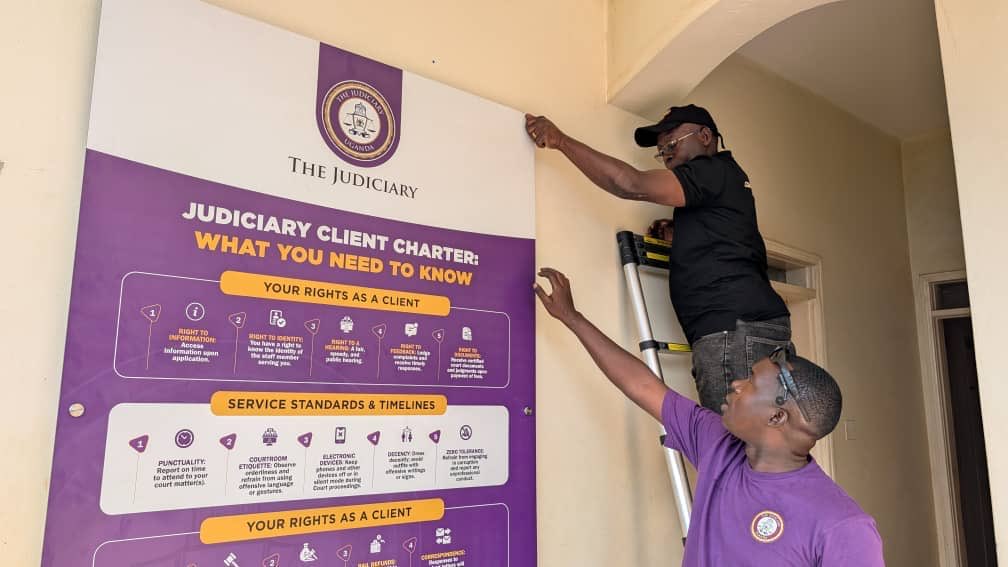
The Judiciary has intensified efforts to improve public access to justice through a nationwide branding and sensitization campaign aimed at increasing awareness of the Judiciary Client Charter and Service Delivery Standards.
The initiative, spearheaded by the Judiciary’s Communications and Public Relations Registry, commenced in the greater Kigezi sub-region with activities conducted at Kabale High Court, Kabale Chief Magistrate’s Court and Ntungamo Chief Magistrate’s Court.
The campaign forms part of broader efforts by the Judiciary to enhance transparency, accountability and service delivery while empowering court users with information about their rights and responsibilities when interacting with the justice system.
Officials say increased public awareness of court processes and service standards is essential in building confidence in the administration of justice and ensuring that citizens can effectively access legal services.
Promoting Transparency and Accountability
The exercise began at Kabale High Court, where the Communications and Public Relations team was received by Assistant Registrar HW Kenneth Tumwebaze.
During the visit, various sections of the court premises were branded with informational materials outlining key provisions of the Judiciary Client Charter.
The materials provide court users with information about services offered by the Judiciary, the standards they should expect while seeking justice, and the available channels for submitting feedback, compliments and complaints.
Judiciary officials said the branding exercise is intended to make important information readily accessible to members of the public whenever they visit court premises.
By clearly communicating service standards and client rights, the Judiciary hopes to strengthen accountability and improve the overall court user experience.
Court Users Sensitized on Their Rights
At Kabale Chief Magistrate’s Court, the team conducted a sensitization session attended by court users, litigants and other stakeholders.
Participants were educated on their rights under the Judiciary Client Charter, including the right to access relevant court information, know the identity of court staff serving them, receive a fair and timely hearing, and obtain certified copies of court documents and judgments upon payment of prescribed fees.
They were also informed of their right to provide feedback and raise complaints regarding service delivery whenever they are dissatisfied with services received.
Speaking during the session, Magistrate HW Nyevu Aziiza encouraged participants to share the information within their communities to help more citizens understand how the justice system operates.
She urged court users to seek clarification whenever they encounter challenges while accessing court services and emphasized the importance of utilizing available complaint and feedback mechanisms.
“Court users have a right to raise concerns whenever they are dissatisfied with the services rendered,” she said.
The magistrate also encouraged the public to use the Judiciary’s toll-free communication channels not only to report challenges but also to recognize and appreciate good service delivery by court staff.
Service Delivery Standards Explained
The sensitization exercise also highlighted the Judiciary’s Service Delivery Standards and timelines, which are designed to improve efficiency and strengthen public confidence in the justice system.
Participants were informed about standards governing the timely delivery of judgments, processing of bail applications, handling of refunds, management of correspondence and responses to client inquiries.
Judiciary officials noted that clearly defined service standards help court users understand what they should reasonably expect when engaging with the courts.
The standards also provide a framework for measuring performance and holding institutions accountable for service delivery.
Legal experts have often pointed to transparency regarding timelines and procedures as a key factor in improving public trust in judicial institutions.
Alternative Dispute Resolution Promoted
As part of the awareness campaign, participants were also sensitized on Alternative Dispute Resolution (ADR) mechanisms available within the Judiciary.
Officials highlighted Court-Annexed Mediation and the Small Claims Procedure as effective alternatives to conventional litigation.
These mechanisms provide faster, less costly and less adversarial avenues for resolving disputes while helping reduce case backlogs within the courts.
The Judiciary has increasingly promoted ADR as part of ongoing reforms aimed at enhancing efficiency and improving access to justice.
By encouraging greater use of mediation and simplified dispute resolution processes, the institution hopes to ensure that more citizens can resolve disputes without lengthy and expensive court proceedings.
Ntungamo Court Welcomes Initiative
The sensitization campaign later moved to Ntungamo Chief Magistrate’s Court, where a similar session was conducted for court users and judicial staff.
Chief Magistrate HW Gordon Muhimbise commended the Communications and Public Relations Registry for extending the programme to Ntungamo.
He described the Judiciary Client Charter as a vital tool for bringing justice services closer to the people and strengthening public understanding of court operations.
“The Charter enables citizens to appreciate their rights, responsibilities and the standards of service they should expect from the Judiciary,” he said.
Muhimbise encouraged participants to pay close attention to the information being shared, noting that informed court users are better equipped to engage with the justice system and demand quality services.
The sensitization sessions at all the courts were facilitated by Communications Officer Deo Akugizibwe.
Expanding the Campaign Nationwide
Following the successful launch of the programme in the Kigezi region, the Judiciary plans to extend the branding and sensitization exercise to additional court stations across the country.
Upcoming activities are expected to cover Rukungiri High Court, Bushenyi High Court, Mbarara High Court and Masaka High Court.
The expansion reflects the Judiciary’s commitment to fostering a more informed public, improving service delivery and ensuring that justice remains accessible to all Ugandans.
As the campaign gathers momentum, officials hope that greater awareness of the Judiciary Client Charter and Service Delivery Standards will empower citizens, strengthen accountability and contribute to a more transparent and responsive justice system.