Museveni, Dangote push $17 billion regional refinery to transform East Africa’s energy economy
Uganda’s commercial oil reserves discovered in the Albertine Graben are expected to position the country among Africa’s emerging oil producers, with first oil exports anticipated after completion of key infrastructure projects, including the East African Crude Oil Pipeline linking Hoima to Tanzania’s port of Tanga.
A proposed multi-billion-dollar regional oil refinery backed by Nigerian industrialist Aliko Dangote could redefine East Africa’s energy landscape, deepen industrialization, and reduce the region’s dependence on imported petroleum products if negotiations with regional governments succeed.
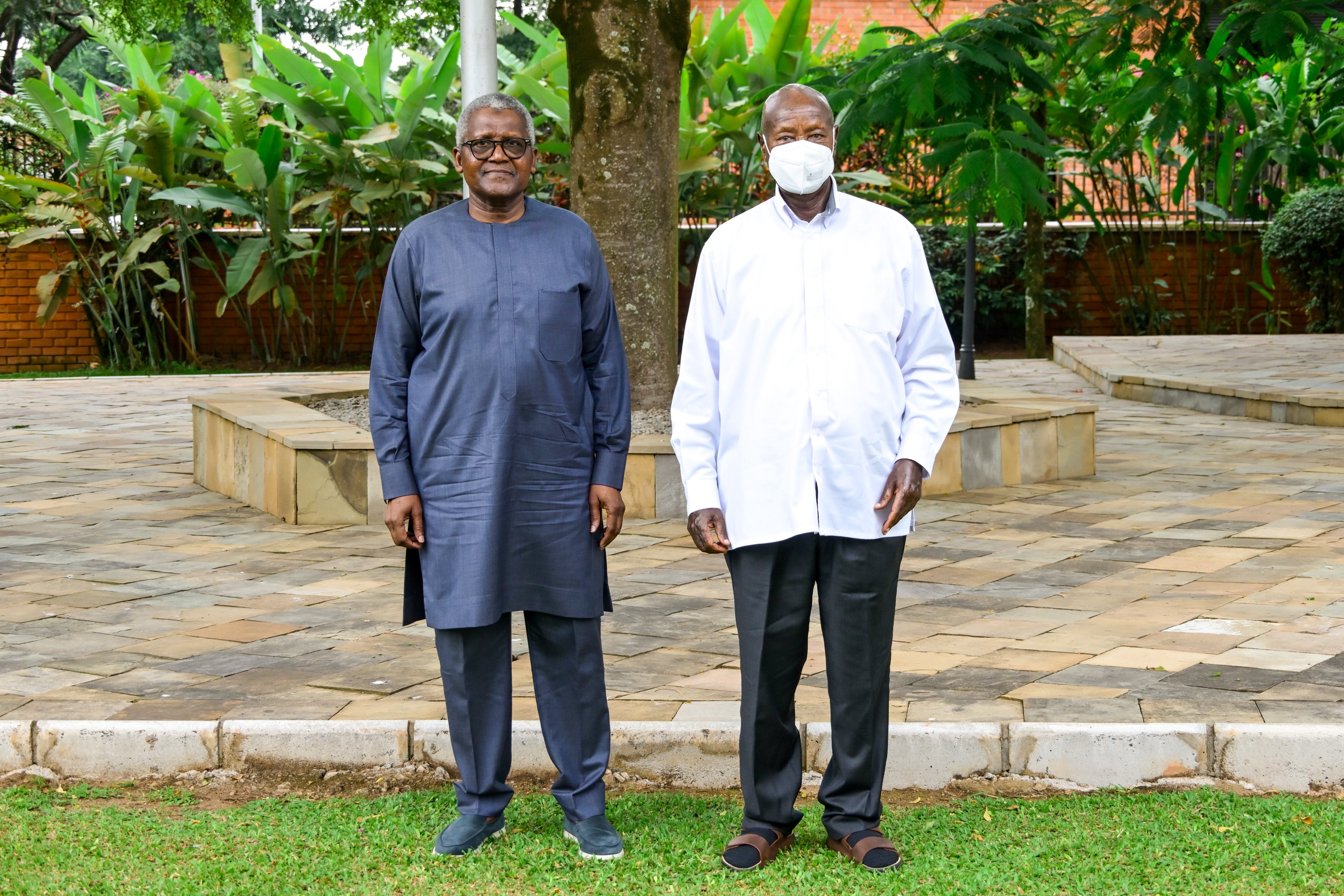
The ambitious refinery project, estimated to cost between $15 billion and $17 billion, was the centerpiece of high-level discussions between President Yoweri Kaguta Museveni and Dangote at State Lodge Nakasero in Kampala, where both leaders explored opportunities for regional energy cooperation and industrial integration.
The proposed refinery is expected to process up to 650,000 barrels of crude oil per day and serve a rapidly growing East African market that includes Uganda, Kenya, Tanzania, Ethiopia, South Sudan, and the Democratic Republic of Congo.
President Museveni said Uganda was prepared to support the regional refinery initiative, including purchasing shares in the project, describing it as an important step toward regional economic integration and value addition.
“We shall support Mr. Dangote, and we are ready to buy shares in the regional refinery because our goal is regional integration and industrial development,” Museveni said.
Shift From Raw Exports to Industrial Value Addition
The discussions reflect Africa’s growing push to move away from exporting raw materials toward local processing and manufacturing.
Museveni emphasized that Uganda has consistently opposed the export of unprocessed crude oil and insisted on establishing domestic refining capacity as part of its oil development strategy.
“We have always been against the export of unprocessed raw materials. That is why Uganda insisted on having a refinery as part of our oil development strategy,” he said.
Uganda’s commercial oil reserves discovered in the Albertine Graben are expected to position the country among Africa’s emerging oil producers, with first oil exports anticipated after completion of key infrastructure projects, including the East African Crude Oil Pipeline linking Hoima to Tanzania’s port of Tanga.
Although Uganda is already developing its own refinery project in Hoima, Museveni clarified that Kampala remains open to supporting a broader East African refinery capable of serving multiple countries and enhancing regional energy security.
“We have no problem supporting a broader regional refinery that can guarantee energy security for the region while Uganda also develops its own refinery,” he noted.
Dangote Eyes East Africa Expansion
For Dangote, whose massive refinery in Lagos has transformed Nigeria’s downstream petroleum sector, East Africa presents a major growth opportunity amid rising regional fuel demand and industrial expansion.
Dangote said feasibility studies and consultations with regional governments are ongoing, with possible refinery locations under consideration including Tanga in Tanzania, Mombasa in Kenya, and Lamu.
“This is a continuation of discussions we held with regional leaders in Nairobi. We want to establish a refinery that can support East Africa’s growing energy needs,” he said.
The businessman explained that the refinery would process crude oil from different regional sources and significantly reduce reliance on imported refined petroleum products, which currently consume large amounts of foreign exchange across East Africa.
Energy analysts say East Africa imports billions of dollars worth of petroleum products annually despite possessing growing oil and gas reserves.
A regional refinery could therefore help stabilize fuel supply, lower import bills, and strengthen energy independence for participating countries.
Economic Impact and Industrial Opportunities
If implemented, the refinery is expected to become one of Africa’s largest industrial investments and could trigger significant economic transformation across the region.
Experts say the project would stimulate growth in manufacturing, logistics, transport, petrochemicals, and construction industries while creating thousands of direct and indirect jobs.
Dangote assured President Museveni that East Africans would benefit from employment opportunities created by the project.
“Jobs will not be a problem. In our refinery in Nigeria, we employ people from many nationalities, and East Africans will also benefit from this project,” he said.
The project could also accelerate infrastructure development, including roads, pipelines, storage facilities, and power generation needed to support refinery operations.
Regional integration experts believe shared energy infrastructure could strengthen trade cooperation under the East African Community and African Continental Free Trade Area frameworks.
Uganda Maintains Confidence in Hoima Refinery
Despite regional refinery discussions, Ugandan officials insist the country’s own refinery project remains commercially viable and strategically important.
Eng. Irene Bateebe, Permanent Secretary at the Ministry of Energy and Mineral Development, said Uganda’s refinery prospects remain strong because of the country’s high-quality crude oil and expanding regional demand.
She explained that Uganda would continue engaging investors and development partners on both the national refinery project and broader regional cooperation initiatives.
Analysts say Uganda’s dual strategy of pursuing domestic refining while supporting regional energy integration could position the country as a central player in East Africa’s future energy economy.
The proposed refinery discussions come at a time when African governments are increasingly seeking long-term energy security solutions amid global geopolitical tensions, volatile fuel prices, and growing industrial demand across the continent.