
UETCL-CEDAT innovation challenge produces new solutions for Uganda’s power transmission sector
Their innovation was selected from projects developed by final-year students at Makerere University’s College of Engineering, Design, Art and Technology (CEDAT) to address practical challenges facing Uganda’s electricity transmission sector.
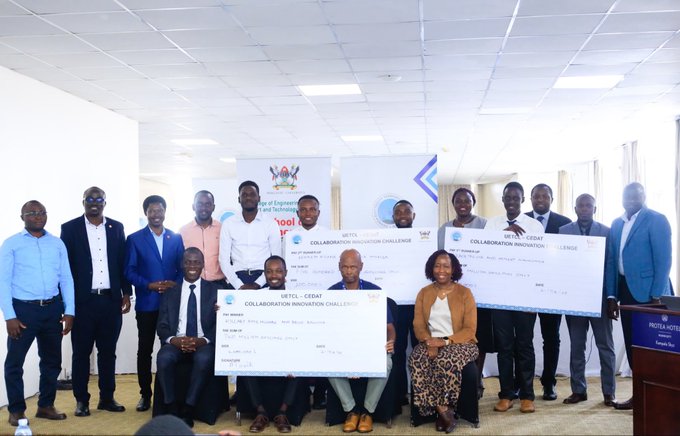
A team of Makerere University students has emerged as the overall winner of the second UETCL–Makerere University CEDAT Post Research Innovation Challenge, after developing a machine learning-based solution to improve monitoring of electricity transmission corridors.
Hillary Aine and Baguma Bruce won the competition with their project titled “Development of a Machine Learning-Based Tool for Wayleave Monitoring of UETCL Transmission Corridors.”
Their innovation was selected from projects developed by final-year students at Makerere University’s College of Engineering, Design, Art and Technology (CEDAT) to address practical challenges facing Uganda’s electricity transmission sector.
The competition, which closed on Friday, provided students with an opportunity to showcase their technical solutions to real-world electricity transmission challenges and defend their approaches before a panel of judges.
The initiative is part of efforts to strengthen collaboration between academia and industry while giving emerging engineers an opportunity to apply classroom knowledge to practical challenges.
Students tackle transmission challenges
The first runners-up were Grace Trevor Nzala and Honest Nimukunda, whose project focused on Optimal Transmission Structure Design for Efficient Power Expansion.
Kenneth Kisaale and Joshua Mukisa emerged as the second runners-up with their project, Development of Transmission Line Routing Optimization Software Tool.
The projects reflect the growing use of digital technologies, engineering design and data-driven approaches to address challenges associated with expanding and managing Uganda’s electricity transmission infrastructure.
During the final presentations, the student teams pitched their ideas, explained their technical approaches and responded to questions from judges as they competed for the top positions.
The challenge tested not only the students’ technical knowledge but also their creativity, innovation and ability to develop solutions to problems encountered in the energy sector.
Industry-academia partnership
UETCL Chief Executive Officer Eng. Richard Matsiko commended the students for developing solutions with potential relevance to the electricity transmission industry.
“Your work solves real problems, builds powerful skills and gives you a true voice in your field,” Matsiko said.
His remarks highlighted the importance of creating platforms through which students can engage directly with industry challenges before entering the professional engineering field.
Prof. Eng. Umaru Bagampadde, representing the Dean of CEDAT, said the university was grateful to UETCL for establishing a platform that connects academic learning with industry needs.
“We are grateful to UETCL for creating a platform that bridges the gap between academia and industry, empowering our students to apply their knowledge in solving real-world challenges,” he said.
The partnership between UETCL and CEDAT is intended to encourage students to move beyond theoretical knowledge and develop practical innovations capable of addressing Uganda’s infrastructure and energy challenges.
Preparing the next generation of engineers
The Chairperson of the UETCL Junior Board, Jesse Nuwandinda, also highlighted the importance of the innovation challenge in preparing young engineers for the demands of the energy sector.
The programme gives students exposure to practical problems while allowing them to engage with professionals and decision-makers within the electricity transmission industry.
For Uganda, such partnerships are increasingly important as the country expands its electricity generation and transmission infrastructure to support industrialisation, urbanisation and economic growth.
Projects focused on transmission corridor monitoring, infrastructure design and route optimisation could contribute to improving the efficiency, planning and management of the national transmission network if developed further for practical application.
Innovation for Uganda’s energy future
The UETCL-CEDAT challenge also demonstrates the potential of universities to serve as centres for research and innovation that respond directly to national development priorities.
The winning machine-learning project, for example, points to opportunities for applying artificial intelligence and data analytics to infrastructure monitoring and management.
Similarly, the projects on transmission structure design and line-routing optimisation demonstrate how engineering students can contribute ideas aimed at reducing costs, improving planning and supporting efficient power expansion.
As Uganda continues to invest in its electricity infrastructure, UETCL and CEDAT say partnerships that connect academic research with industry requirements will remain important in developing a skilled workforce and locally relevant technological solutions.
The second edition of the innovation challenge has therefore provided more than a platform for competition. It has created a pathway for young engineers to engage with real industry problems, test their ideas and potentially contribute to the future development of Uganda’s electricity transmission sector.
The organisers congratulated all participating students and reaffirmed the value of the partnership in turning young ideas and research into practical solutions for Uganda’s energy future.