Medical Intern Standoff: Uganda’s public health system under pressure as doctors threaten nationwide strike
UMA is demanding a monthly internship allowance of Shs4 million, equivalent to 75 percent of a medical officer’s salary, arguing that interns require financial support for accommodation, transport, meals and other basic needs while undertaking their mandatory professional training.
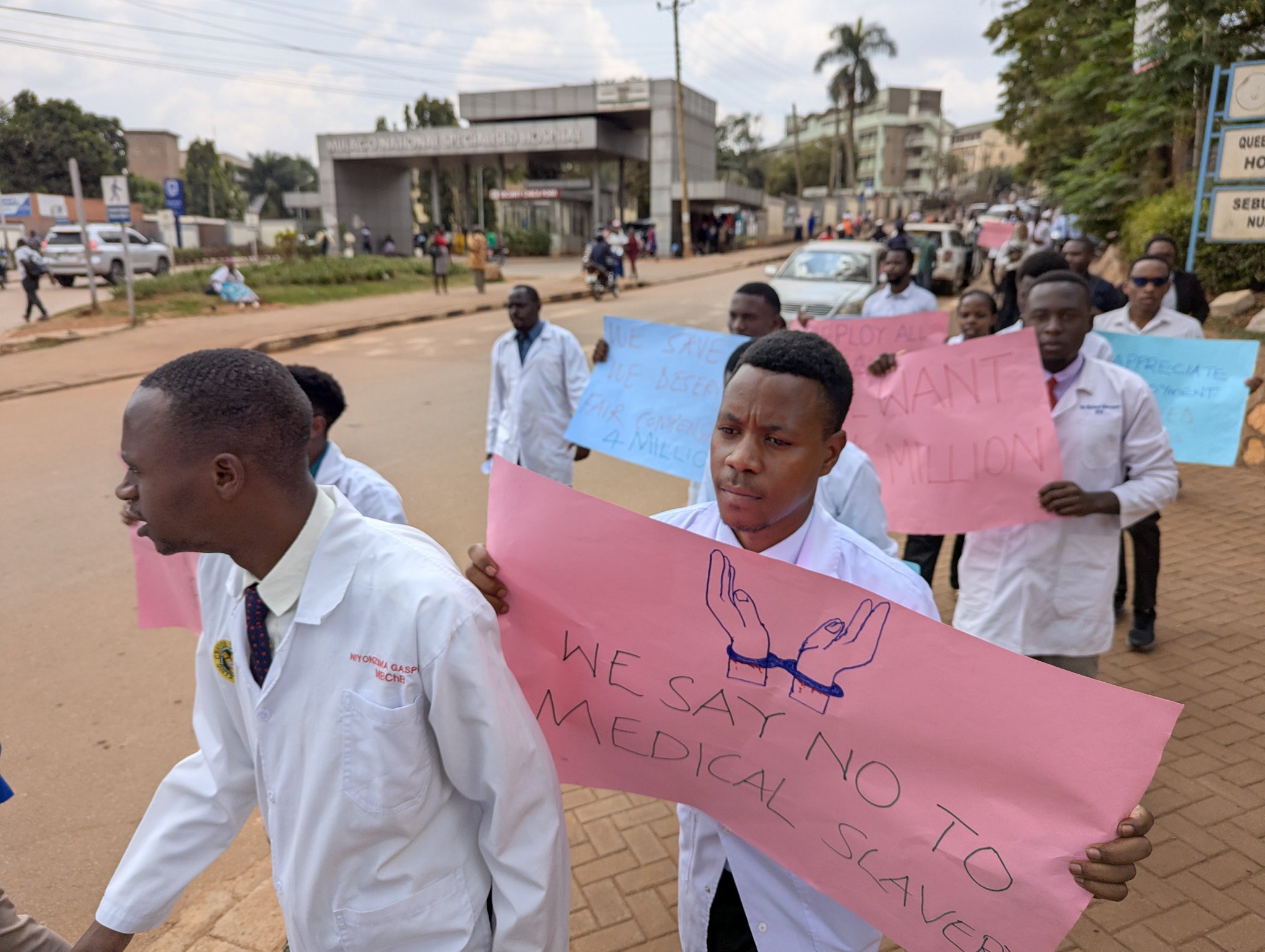
Uganda’s medical internship crisis is escalating into a wider confrontation between the medical profession and government, with the Uganda Medical Association (UMA) warning that doctors could withdraw their services if the Ministry of Health fails to resolve the deployment and welfare concerns of medical interns.
The warning follows an Extraordinary General Assembly attended by about 4,500 doctors from Uganda and the diaspora, where 99 percent of participants reportedly endorsed full solidarity with medical interns who have declined to report to their assigned facilities pending guarantees on their welfare and deployment.
The dispute has brought renewed attention to the difficult transition faced by newly qualified doctors entering Uganda’s public health system, where mandatory supervised practice is a prerequisite for full professional deployment.
Welfare at the centre of the dispute
At the heart of the disagreement is the question of how medical interns will survive during their one-year internship.
UMA is demanding a monthly internship allowance of Shs4 million, equivalent to 75 percent of a medical officer’s salary, arguing that interns require financial support for accommodation, transport, meals and other basic needs while undertaking their mandatory professional training.
The association says deployment without a clear and sustainable source of income would place interns in financially unsustainable living conditions and could ultimately affect patient care.
UMA has therefore backed the interns’ decision to remain at home until the Ministry of Health provides clear deployment instructions and guarantees adequate financial facilitation throughout the internship period.
The association says 2,417 eligible medical interns should be deployed to accredited training sites across the country without discrimination or punitive withdrawal of deployment orders.
Doctors set 14-day deadline
The dispute could soon spill beyond the internship programme.
According to the resolutions adopted by the General Assembly, doctors across Uganda will begin industrial action after 14 days if the Ministry of Health does not provide clear, written and satisfactory communication on the deployment and facilitation of medical interns.
UMA, however, says emergency care and other essential life-saving services would continue during any industrial action.
The association has also identified circumstances that could trigger immediate industrial action without waiting for the 14-day deadline.
These include what UMA describes as threats, intimidation or punitive action against interns who have raised concerns about their welfare, as well as any withdrawal of deployment orders as a form of punishment or discrimination.
Unpaid doctors add pressure
The internship dispute is also connected to a broader concern over delayed government payments to health workers.
UMA is demanding the immediate release of outstanding funds owed to more than 300 medical interns, residents and fellows who, according to the association, have remained unpaid since July 2025 despite having government contracts.
The association is also demanding a written government commitment that compensation for interns will be included in future deployment letters.
The doctors want the government to withdraw or suspend the National Education and Training for Health Policy to allow for what they describe as genuine and inclusive consultation with stakeholders.
These demands, UMA says, are among commitments that were promised by senior government officials on the floor of Parliament.
Beyond internships: a health system under pressure
For UMA, the internship dispute is symptomatic of deeper structural problems within Uganda’s health sector.
The association is calling for increased healthcare financing and a clear roadmap towards the 15 percent health expenditure target under the Abuja Declaration.
It is also demanding the lifting of the recruitment ban in the health sector and a deliberate strategy to address what it describes as severe shortages of doctors.
UMA says Uganda’s doctor-to-patient ratio is approximately one doctor for every 25,000 people, compared with a World Health Organization benchmark of one doctor for every 1,000 people. The association says staffing levels remain below 30 percent of required levels.
The figures, if left unaddressed, raise broader questions about the capacity of the public health system to deliver timely and quality care as the country’s population and demand for healthcare continue to grow.
Pay and career stagnation
The association is also demanding action on salary disparities affecting associate consultants and what it describes as widespread career stagnation among medical officers.
According to UMA, some medical officers remain in the same position for more than a decade despite acquiring the qualifications required for promotion.
For doctors, such challenges contribute to stress, burnout, absenteeism, presenteeism and declining morale within the profession.
The association argues that addressing remuneration, staffing, career progression and working conditions is essential not only for the welfare of healthcare workers but also for patient safety and the sustainability of Uganda’s health system.
The bigger question: who carries the public health system?
UMA’s strongest argument is that medical interns should not be treated simply as university students.
The association describes them as qualified doctors undergoing a mandatory one-year period of supervised practice before taking on greater responsibility for life-and-death clinical decisions.
It further claims that interns provide as much as 70 percent of frontline healthcare delivery at some facilities where they are deployed.
That claim underscores the potentially significant impact of the current standoff. If thousands of interns remain away from hospitals, health facilities that rely heavily on them could face additional pressure, particularly in already understaffed departments.
For patients, the dispute therefore goes beyond the question of internship allowances. It touches on the availability of doctors, continuity of care and the ability of public hospitals to maintain essential services.
A test for government and the health sector
The crisis now presents government with a difficult balancing act: addressing legitimate welfare concerns among young doctors while protecting continuity of healthcare services and managing public expenditure pressures.
For UMA, however, the issue is ultimately about investing in the people responsible for delivering healthcare.
The association says it remains committed to dialogue with government but will defend what it considers the rights, safety and welfare of healthcare practitioners.
The coming days will therefore be critical. Whether the dispute is resolved through negotiation or develops into a wider industrial action could have significant implications for Uganda’s already stretched public healthcare system.
At the centre of the standoff are 2,417 young doctors waiting to begin a crucial stage of their professional careers, and a health system that depends heavily on their presence at the bedside.