
Can Uganda’s financial sector fund the tenfold growth agenda? Experts make critical demands
Bank of Uganda Governor Michael Atingi-Ego said private sector credit must rise from just under Shs30 trillion currently to more than Shs490 trillion if Uganda is to finance a US$500 billion economy by 2040.
Uganda’s ambition to grow its economy tenfold to US$500 billion by 2040 will require a dramatic expansion of private sector financing, with the banking industry being challenged to build the capital, risk management systems and balance-sheet capacity needed to support growth on an unprecedented scale.
Bank of Uganda Governor Michael Atingi-Ego said private sector credit must rise from just under Shs30 trillion currently to more than Shs490 trillion if Uganda is to finance a US$500 billion economy by 2040.
He made the remarks on Friday while speaking at the 2nd Annual Research Conference of the Uganda Institute of Banking and Financial Services (UIBFS) held under the theme, “Financial Sector Research as a Catalyst for Uganda’s Ten-Fold Economic Growth Agenda.”
The Governor said the scale of financing required demands a fundamental transformation in how financial institutions approach lending, risk and capital.
Banks, he said, must “build the capital, the risk governance, and the balance sheet capacity to lend at a scale and pace this country has not previously attempted.”
The challenge highlights the central role of Uganda’s financial sector in translating the government’s long-term economic ambitions into actual investment, business expansion and job creation, regulation must support growth
Atingi-Ego said financial sector regulation must evolve alongside Uganda’s growth ambitions, promising a proportional and forward-looking approach from the central bank.
“Regulation, done well, is the mechanism that lets ambition and safety advance together,” he said.
He also challenged researchers and financial sector players to subject existing assumptions to evidence, particularly in emerging areas such as credit scoring, climate exposure, capital markets and supervisory technology.
“Test our assumptions on credit scoring, climate exposure, capital market behaviour, and supervisory technology, and hold us to what the data shows,” the Governor told participants.
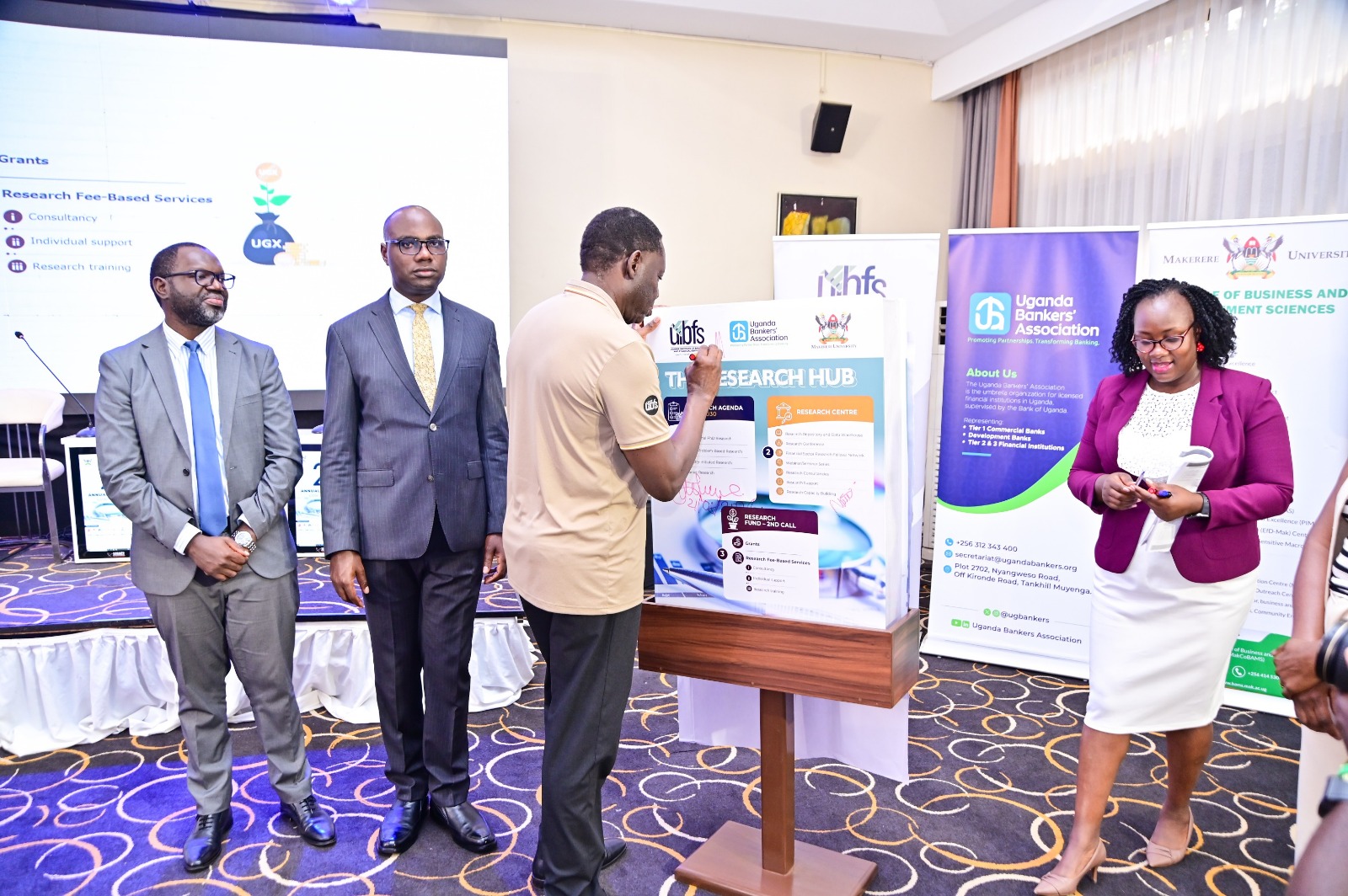
The conference also saw the symbolic launch of the Financial Sector Research Hub, comprising three components: a Research Agenda for 2026–2030, a Research Fund and a Research Centre.
The initiatives are intended to strengthen the use of evidence-based research in financial sector policymaking and institutional decision-making, government calls for cheaper, longer-term finance
Finance Minister Henry Musasizi said the financial sector has an important role to play in aligning its strategies with Uganda’s Ten-Fold Growth Agenda.
He said the push towards a US$500 billion economy comes at a critical period when Uganda must mobilise more domestic resources, prepare for oil revenues and ensure that public finances remain sustainable.
“My new assignment comes at the time when Uganda must grow its economy to USD 500 billion by 2040, when domestic resources to finance government obligations must grow and when the expected oil revenue must be managed well without distorting the economy,” Musasizi said.
He stressed that growth must be inclusive, ensuring that people across different levels of society participate in the transformation agenda.
The Minister also identified budget discipline as a core requirement for delivering Vision 2040.
Musasizi challenged UIBFS researchers to focus on ways of growing long-term patient capital, deepening financial inclusion and lowering the cost of credit.
He said government was prepared to use evidence-based research in policymaking, while urging financial institutions to prioritise financing the real economy by developing appropriate products and reducing the cost of borrowing.
Other research priorities identified by the Minister include digital finance and fintech, capital markets, domestic revenue mobilisation, climate finance and green growth.
Credit market needs better data
The conference also placed data and credit information at the centre of efforts to expand lending while managing risks.
Mark Mwanje of Creditinfo highlighted the importance of robust know-your-customer processes, secure digital onboarding and intelligent use of data in identifying emerging credit risks.
“Inconsistency means higher risk. Consistency means higher trust,” Mwanje said.
He disclosed that 266,719 loans had remained unpaid for six consecutive months, representing an exposure of Shs332.2 billion.
The figures underline the growing importance of stronger risk management as mobile lending continues to increase the volume and speed of credit delivery.
Speakers argued that better credit information could allow financial institutions to distinguish between high- and low-risk borrowers and expand lending without compromising financial stability.
Andrew Njeru of CIS Kenya urged lenders to avoid blanket approaches to credit decisions.
“Let us not do lazy lending. One size fits all,” he said, calling for stronger credit information sharing and more accurate data to support responsible lending.
AI presents new opportunities — and risks
The conference also examined the growing role of artificial intelligence in financial services.
Amos Otieno Okech, Data Science Leader at the Kenya Bankers Association, said AI could improve credit scoring, expand access to finance and strengthen risk decision-making.
However, he identified data quality, explainability and governance as critical foundations for responsible AI adoption.
“Before asking ‘how accurate is this model?’, ask ‘can we explain this decision?’” Okech said.
His message was that financial institutions must ensure AI-driven decisions are transparent, accountable and based on reliable data if technology is to deliver sustainable benefits.
Products must match Uganda’s economy
Godfrey Sebaana, UIBFS Board Chairperson and Chief Executive Officer of Diamond Trust Bank Uganda, said the financial sector must develop a deeper understanding of Uganda’s priority sectors and their value chains.
He challenged banks to translate research into products that address the evolving needs of Ugandans.
“Without proper products, we cannot be relevant; we cannot respond to the challenges our people require us to resolve in order to transform our country,” Sebaana said.
He also pointed to mobile money and the expanding agent banking network as important drivers of financial inclusion, while stressing the need for continuous professional development within the sector.
Meanwhile, Wilbrod Humphreys Owor, Executive Director of the Uganda Bankers’ Association, called for stronger links between academic research and practical industry challenges.
He said research should focus on low credit penetration, SME financing, digital lending and financial inclusion.
“We want to make more and more businesses, particularly SMEs, eligible to access credit because they have the highest multiplier effect across the economy,” Owor said.
He noted that Uganda’s credit-to-GDP ratio remains low and urged researchers to develop locally relevant models capable of expanding the borrower base, turning research into action
UIBFS Chief Executive Officer Goretti Masadde said the conference was intended to move financial sector discussions beyond theory and towards practical action.
“Data is gold, but the real question is: what are we going to do differently?” Masadde said.
She challenged stakeholders to identify what they should start, stop and do differently based on evidence and lessons from across the region.
The conference, organised by UIBFS in partnership with the Uganda Bankers’ Association and Makerere University’s College of Business and Management Sciences, brought together policymakers, researchers, banking executives and development partners.
For Uganda’s US$500 billion ambition to become achievable, the discussions suggest that the financial sector will need to do more than simply increase lending. It will have to mobilise patient capital, improve credit information, embrace responsible technology, develop fit-for-purpose financial products and strengthen risk management.
The scale of the task is clear: moving private sector credit from below Shs30 trillion to more than Shs490 trillion by 2040 will require not only more money in the financial system, but also a fundamental shift in how Uganda finances businesses and economic transformation.