
From Ideas to Investment: How Uganda’s Women Tech entrepreneurs are building businesses that solve real problems
For the 20 founders, the next several months will be a test of how effectively they can apply the lessons, networks and resources provided by the accelerator.
For Uganda’s growing community of women technology entrepreneurs, the challenge is increasingly moving beyond developing innovative ideas to building businesses capable of surviving, attracting investment and scaling their impact.
That challenge is at the heart of the second cohort of the Women in Tech Uganda Accelerator Programme, which has brought together 20 women-led, technology-enabled startups working on solutions in agriculture, education, healthcare, renewable energy, accessibility and financial inclusion.
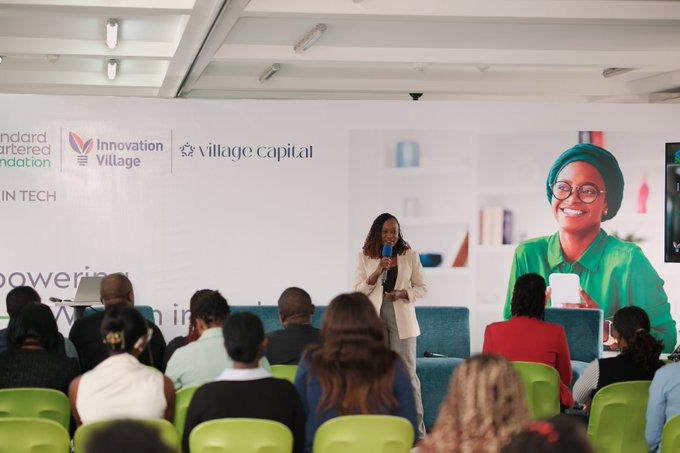
The 2026 cohort was unveiled during a “Meet the Leadership” session at Standard Chartered Uganda’s head office in Kampala, where the founders met programme leaders, mentors, ecosystem partners and alumni from the first cohort.
Implemented by Standard Chartered Uganda in partnership with Innovation Village, Village Capital and Future Lab, the programme is positioning entrepreneurship support as more than classroom training—combining mentorship, business development, market access, investment preparation and catalytic funding.
The difficult journey from founder to CEO
For many entrepreneurs, developing an innovative product is only the beginning.
As businesses grow, founders must learn how to manage people, understand financial performance, secure customers, build systems and make decisions that allow the enterprise to operate beyond the founder.
That transition was highlighted by Keroy King, Founder and Managing Director of Sunshine Financial Services and a graduate of the first Women in Tech cohort.
Her business, based in Kitintale, provides financial services to market vendors, boda boda riders and communities that may face barriers accessing conventional financial services.
King shared lessons from her own entrepreneurial journey, including the consequences of hiring the wrong people, managing cash flow and learning to establish boundaries.
Her experience demonstrated the realities behind the often-celebrated image of entrepreneurship: businesses can have promising ideas but still struggle with people management, financial discipline and operational sustainability.
She told the new founders that mentorship, understanding their numbers and resilience have helped her build a stronger and more sustainable enterprise.
Building businesses, not just products
The accelerator’s philosophy is centred on helping founders turn technology solutions into viable businesses.
Margaret Kigozi, Standard Chartered Uganda’s Head of Corporate Affairs, Brand and Marketing, said the bank believes women-led technology businesses can generate significant economic and social impact.
“We believe in the potential of women-led tech businesses and the impact they can create,” she said.
The programme will provide support in business model refinement, digital adoption, market validation, financial management, leadership development and investor readiness.
The approach reflects a growing recognition that innovation alone does not guarantee commercial success. Startups also need strong business models, reliable revenue streams, effective leadership and the ability to demonstrate value to customers and investors.
The investment readiness challenge
Access to capital remains one of the major hurdles for early-stage businesses.
The accelerator is therefore designed to help founders become more prepared to engage investors by strengthening their financial management, business models and pitches.
The strongest-performing startups will compete for catalytic grant funding from a US$50,000 pool, providing additional resources to strengthen operations and support expansion.
However, the programme’s organisers are also emphasising that funding should follow a stronger business proposition rather than substitute for one.
Roselyn Najjuma, Head of Transaction Banking and Country Lead for Sustainable Finance, urged the founders to prepare for the transition from founder-led operations to scalable leadership.
She encouraged them to build networks, sharpen their pitches and develop leadership skills as their companies grow.
The message is particularly relevant for startups seeking to move from serving a small customer base to operating at scale.
Stay close to the problem
Programme coach Rowena Turinawe challenged the founders to avoid becoming too attached to their solutions.
Instead, she encouraged them to remain focused on the problems they are trying to solve and be willing to adjust their products when evidence from customers and markets demands it.
That principle is critical for startups operating in sectors such as agriculture, healthcare and financial inclusion, where technology must respond to real-world needs and affordability constraints.
Turinawe said the Women in Tech programme stands out because founders are encouraged to ask practical questions, apply lessons immediately and measure the impact on their businesses.
Technology tackling everyday challenges
The diversity of the second cohort illustrates how technology entrepreneurship in Uganda is moving beyond conventional software development.
The startups are addressing challenges across agricultural production, education, healthcare, clean energy, accessibility and financial services.
For example, technology-enabled solutions in agriculture can potentially improve access to markets and information, while innovations in healthcare can help address gaps in service delivery.
In financial inclusion, technology is creating new ways of reaching customers who have traditionally been underserved by formal institutions.
The common thread is the use of technology to solve practical problems while creating commercially sustainable enterprises.
A bigger economic opportunity
The programme also reflects a broader opportunity for Uganda’s economy.
As digital technologies become increasingly important to business and public services, women entrepreneurs have an opportunity to participate in sectors that are shaping future employment, investment and innovation.
Yet turning that opportunity into sustained economic impact requires more than access to technology.
Entrepreneurs need capital, mentorship, networks, markets and the management capabilities required to grow.
That is the gap the accelerator is seeking to address.
The programme is part of the Standard Chartered Foundation’s global youth economic empowerment initiative, which focuses on employability, entrepreneurship, decent work and microbusiness growth.
For the 20 founders, the next several months will be a test of how effectively they can apply the lessons, networks and resources provided by the accelerator.
Their success will ultimately be measured not by the number of workshops attended, but by whether their businesses generate sustainable revenues, create jobs, attract investment and deliver measurable solutions to the problems they set out to solve.
The second Women in Tech cohort therefore represents a broader experiment in Uganda’s innovation economy: can targeted support help women-led startups move from promising ideas to durable, scalable businesses?
The answer may offer important lessons for the future of Uganda’s digital economy, and for the growing number of women seeking to build businesses through technology.