Netherlands emerges as Uganda’s top FDI source as Dutch investors seek better business environment
Investors also raised concerns about access to tax incentives, the treatment of different business models and implementation of the Protection of Sovereignty Act.
The Netherlands has emerged as one of Uganda’s largest sources of foreign direct investment (FDI), with more than 200 Dutch-affiliated companies operating across the economy, as the Government moves to deepen engagement with investors and address barriers to doing business.
Head of the State House Investors Protection Unit (SHIPU), Col. Edith Nakalema, said Dutch investments are playing an important role in Uganda’s agriculture and agribusiness, renewable energy, transportation and logistics sectors.
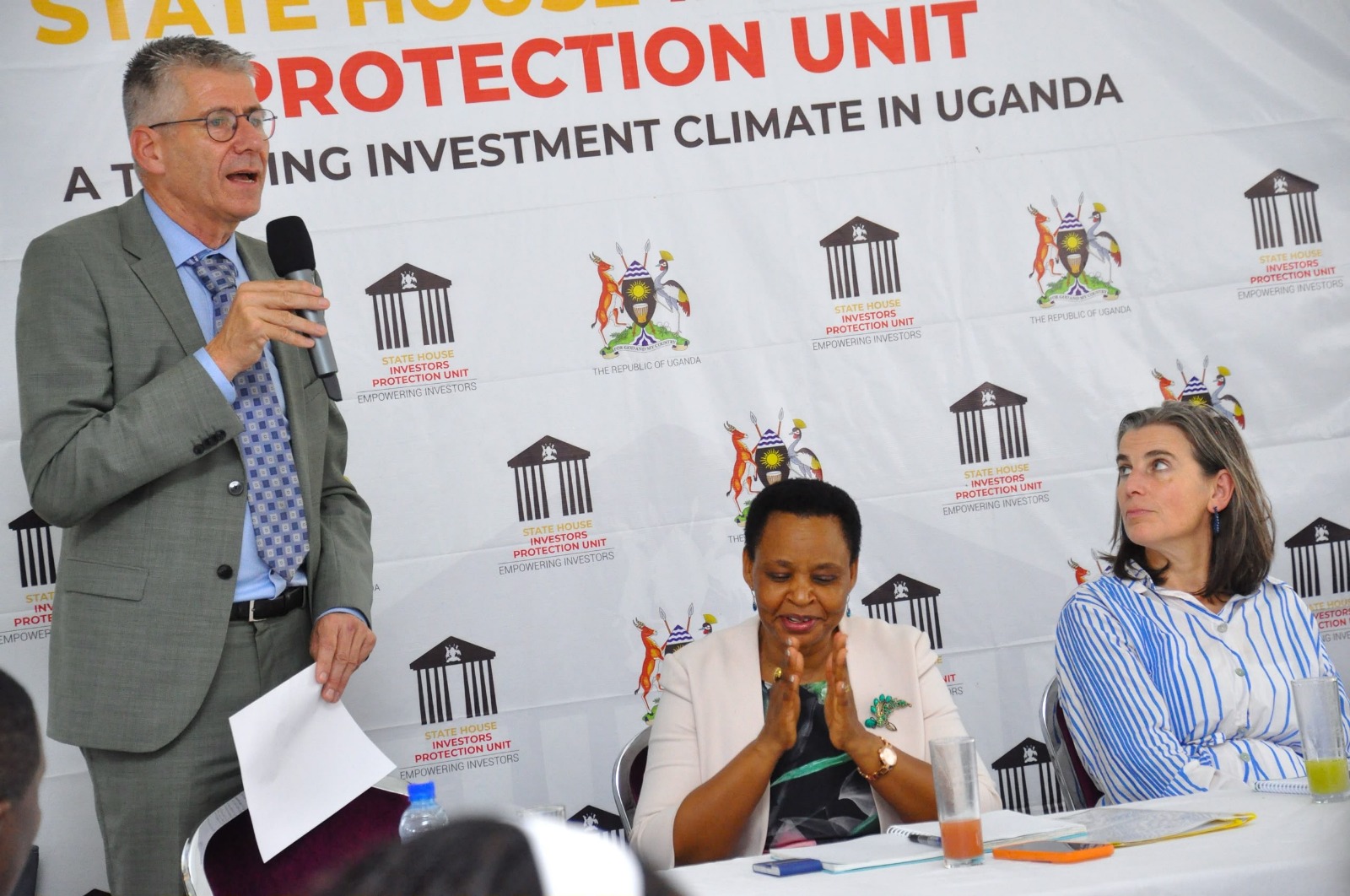
She made the remarks on Wednesday, October 7, 2026, during a strategic trade and investment engagement with members of the Netherlands-Uganda Trade and Investment Platform (NUTIP) at SHIPU offices in Kampala.
The meeting brought together government agencies and Dutch business representatives to address challenges affecting investors, including taxation, tax arbitration, economic policy and governance.
Col. Nakalema said the Netherlands accounted for 58.8 percent of total FDI inflows into Uganda by June 2026, underscoring the country’s growing importance as an investment partner.
Dutch-affiliated companies are particularly active in horticulture, floriculture, animal and fish feed manufacturing and aquaculture.
Beyond capital inflows, Nakalema said Dutch investments contribute to innovation, employment creation, local capacity development and other economic opportunities for Ugandans.
SHIPU targets zero-delay investment environment
Nakalema assured investors that SHIPU is working to create a more coordinated investment environment in which government agencies collaborate to resolve investor concerns and minimise unnecessary delays.
She said President Yoweri Kaguta Museveni established SHIPU with a directive to make Uganda a “zero-delay destination” for domestic and foreign investors.
“Our mandate is therefore to protect your capital from economic disruptions by deploying collaborative mechanisms, as MDAs, to expedite attention to any concerns that may set you back,” she said.
She also urged NUTIP members to make greater use of the Electronic Investors’ Protection Portal (EIPP), which was commissioned by President Museveni in December 2023.
The digital platform links more than 75 government Ministries, Departments and Agencies, enabling investors to undertake due diligence and verify administrative processes with reduced human interaction.
Netherlands shifts from aid to investment
Deputy Ambassador of the Netherlands to Uganda, Bouwe-Jan Smeding, said both countries share an interest in improving Uganda’s business environment.
He said a stronger investment climate would help Uganda attract foreign exchange and enable businesses to operate profitably.
Smeding also pointed to a strategic shift in the Netherlands’ engagement with Uganda—from traditional development cooperation towards a more investment-oriented relationship.
He said the Netherlands’ Multiannual Country Strategy for 2026 onwards reflects this approach while maintaining support for areas such as smallholder agriculture.
The envoy said tax administration remains one of the areas requiring continued dialogue, particularly around policy clarity and the resolution of tax disputes.
Economic pressures weigh on investors
Moses Kaggwa, Director of Economic Affairs at the Ministry of Finance, Planning and Economic Development, said Uganda is navigating external economic pressures, including rising fuel prices, geopolitical tensions in the Middle East and exchange-rate movements.
He said the Government and Bank of Uganda were monitoring the situation and taking measures to contain excessive depreciation and inflation.
Despite these pressures, Kaggwa said Uganda’s export performance remains strong, with exports expected to reach about US$18.42 billion.
He cited coffee, cocoa and vegetables exported to the European Union among the products supporting Uganda’s foreign-exchange earnings.
Kaggwa said Government is seeking to build an economy driven by production and value addition rather than imports and retail trade. Manufacturing accounts for about 15 percent of GDP, he said, while agriculture, tourism, minerals, science, technology and industry remain key pillars of the country’s transformation agenda.
Investors seek clarity on taxes and regulations
NUTIP Board Chairperson Mark Dieleman called for stronger cooperation between government and the private sector, arguing that a vibrant business community is essential to economic growth.
“No business, no economy. It’s as simple as that,” he said.
Investors also raised concerns about access to tax incentives, the treatment of different business models and implementation of the Protection of Sovereignty Act.
NUTIP board member Donah Loyce Katushabe called for clarity on strategic investor exemptions under the Income Tax Act and raised concerns about foreign companies supplying goods from abroad being contracted in foreign currency.
Meanwhile, the Uganda Revenue Authority said it remains committed to facilitating investors and avoiding unnecessary delays.
Abel Kagumire, representing the URA Commissioner General, said eligible raw materials can benefit from duty-remission mechanisms under Uganda and East African Community arrangements.
The engagement signals an effort by Uganda and the Netherlands to convert strong investment ties into a more predictable and responsive business environment, as both sides seek to expand trade, investment and economic opportunities.