A $500bn Economy: Uganda’s industrial future lies in private capital, productivity and exports – Ggoobi
Ggoobi said the economy had expanded from approximately $50 billion in 2023 to more than $70 billion, with the next milestone being to cross $100 billion before 2030.

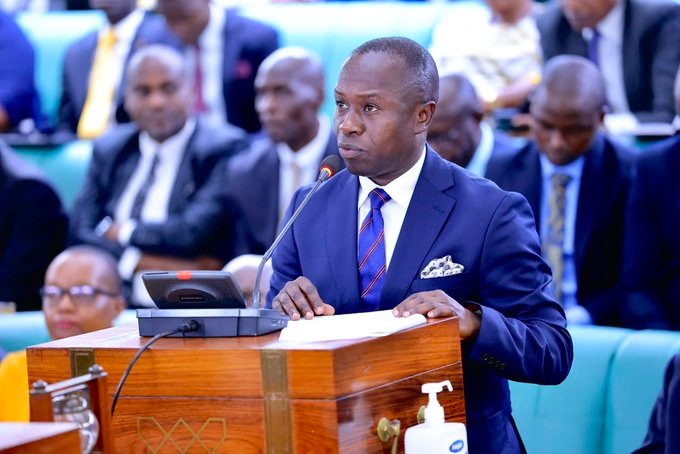
Uganda must shift from government-funded industrial projects to a private capital-driven model that prioritises competitive value chains, exports and domestic production, Permanent Secretary and Secretary to the Treasury Ramathan Ggoobi has said.
Ggoobi said the country’s ambition to grow its economy from approximately $70 billion to $500 billion by 2040 would require a fundamental rethink of how government finances, coordinates and measures industrial development.
He argued that Uganda’s next phase of industrialisation should focus less on government spending and more on using public investment to attract private capital, build productive capabilities and develop commercially sustainable enterprises.
“Uganda’s next industrial revolution will not be won merely by Government spending more, but by Government investing better, coordinating better, mobilising private capital more effectively, and demanding measurable results,” Ggoobi said.
He was delivering the keynote address at the Uganda Industrialisation Conference 2026 at Speke Resort Convention Centre in Munyonyo on November 18, during celebrations marking 10 years since the re-establishment of the Uganda Development Corporation (UDC).
Ggoobi said the economy had expanded from approximately $50 billion in 2023 to more than $70 billion, with the next milestone being to cross $100 billion before 2030.
However, he cautioned that achieving the $500 billion target would require sustained double-digit growth in nominal US-dollar GDP, supported by productivity, investment, exports and macroeconomic stability.
Mobilising private capital
A central pillar of Ggoobi’s proposed industrial policy is transforming UDC into a catalytic equity investor that takes on pioneering investment risks, develops bankable projects and attracts private-sector co-investors.
He revealed that UDC’s investments had exceeded Shs1.5 trillion, while Uganda Development Bank’s capitalisation had reached Shs2.6 trillion.
He said the institutions must use these resources to unlock additional private investment and generate measurable economic returns rather than becoming permanent sources of government financing for commercially unviable businesses.
“UDC should increasingly become a catalytic equity investor—identifying commercially viable opportunities, sharing pioneering risks, structuring bankable projects and attracting private co-investors,” he said.
Uganda Development Bank will complement this role by providing appropriately structured development finance to productive enterprises.
Ggoobi also called for greater participation of domestic institutional investors, including pension funds, in viable industrial investments, subject to their fiduciary obligations and prudential requirements.
He emphasised that public capital must be deployed selectively, with every investment assessed against its ability to address market failures, attract private financing and deliver measurable economic benefits.
Manufacturing competitiveness challenge
Ggoobi said Uganda’s industrialisation ambitions were being constrained by low manufacturing productivity, underutilised factory capacity and limited manufactured exports.
Manufacturing value added currently accounts for approximately 13% of GDP, below the national target of 16%, while capacity utilisation in the sector stands at about 52%.
Industry accounts for approximately 12.4% of total employment, while manufactured goods contribute less than a quarter of merchandise exports, against the Tenfold Growth Strategy target of 50%.
He said these indicators demonstrated the need to move beyond establishing factories towards building competitive enterprises capable of producing at scale and penetrating regional and international markets.
He proposed concentrating resources on selected value chains where Uganda has the potential to develop competitive capabilities, including agro-processing, mineral beneficiation, petroleum-related industries and other commercially viable manufacturing opportunities.
He also urged government to strengthen domestic production linkages by ensuring that major investments create opportunities for Ugandan farmers, suppliers, transporters and small businesses through local sourcing, skills development and technology transfer.
Reducing the cost of doing business
The Treasury chief identified high production costs as another major obstacle to industrial competitiveness, arguing that tax incentives alone cannot compensate for expensive electricity, transport, financing and regulatory inefficiencies.
He cited investment in the Standard Gauge Railway and rehabilitation of the Metre Gauge Railway as part of efforts to reduce freight costs and improve market access.
He said government must also ensure that industries receive reliable electricity at competitive tariffs, while training institutions produce the technical skills required by modern manufacturing.
Ggoobi proposed developing a National Industrial Competitiveness Scorecard to benchmark electricity costs, freight charges, access to finance, regulatory efficiency, labour productivity and export performance against competing manufacturing destinations.
He said Uganda should also measure industrial success by productivity, quality employment, domestic value addition and export performance rather than the number of factories commissioned.
A new performance framework for UDC
As UDC enters its second decade, Ggoobi said the corporation should transition from institutional rebuilding to measurable industrial transformation.
He proposed five indicators for assessing its performance: additional private investment mobilised, commercial returns relative to risks, export earnings and domestic value addition, sustainable employment, and management of underperforming investments.
He further called for commercially viable enterprises established by UDC to attract additional private ownership through strategic sales and capital-market transactions, allowing government to recycle capital into new industrial opportunities.
Ggoobi proposed an Industrial Transformation Implementation Compact for 2026–2030, bringing together government, UDC, the private sector and development institutions.
The proposed framework would identify high-potential industrial value chains, develop bankable investment projects, establish competitiveness benchmarks, strengthen UDC’s commercial governance and introduce annual performance reviews.
He said Uganda’s challenge was no longer a shortage of industrial policies but the persistent gap between policy ambition and implementation.
“The next fifteen years must therefore be different. We must move from measuring expenditure to measuring results; from celebrating factory openings to celebrating actual value addition,” he said.
The proposed approach is aligned with the Tenfold Growth Strategy, which identifies agro-industrialisation, tourism, mineral-based industrialisation, including oil and gas, and science, technology and innovation as the four priority growth areas.