Fiscal Discipline: The missing link between government spending and economic growth; and why govt must respond by cutting Public Expenditure
One of the major priorities outlined by Musasizi is improving budget credibility through more realistic revenue forecasting, prudent expenditure management and reducing avoidable supplementary budget requests.

Government has pledged to tighten public expenditure management and improve budget execution, amid concerns that revenue shortfalls, unpredictable spending and delays in implementing development projects could undermine the impact of public investment on Uganda’s economy.
Finance Minister Henry Musasizi says Government will prioritise fiscal discipline, realistic budget planning and stronger accountability to ensure public resources translate into productive investments, improved service delivery and sustainable economic growth.
The commitment comes as Uganda seeks to sustain its economic expansion while managing competing demands for public resources, including infrastructure development, social services and investment in productive sectors.
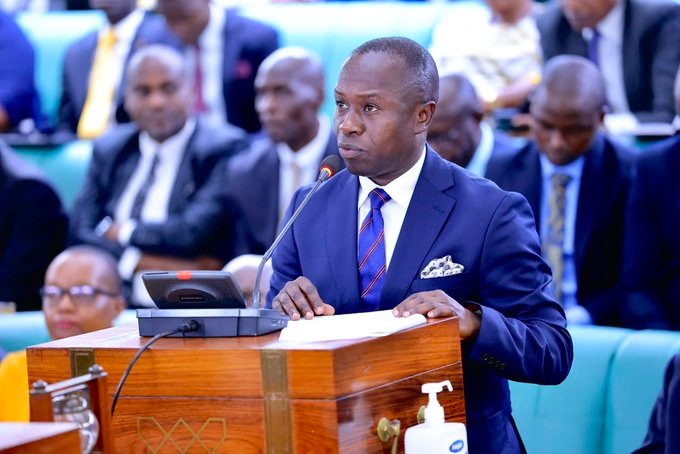
Appearing before Parliament’s Committee on Finance, Planning and Economic Development, chaired by West Budama County North MP Ochai Maximus, Musasizi said the Ministry of Finance would strengthen controls over public spending and address weaknesses affecting budget implementation.
He said the effectiveness of public expenditure should be judged by the economic and social outcomes it generates rather than the amount of money allocated or spent.
“The credibility of public financial management is ultimately measured not by the size of the budget or the level of expenditure alone, but by the tangible results achieved for the people of Uganda,” Musasizi said.
The Minister was presenting the Ministry’s strategic priorities and accounting for its performance during the 2025/26 financial year and the first quarter of 2026/27.
Focus on quality of public spending
One of the major priorities outlined by Musasizi is improving budget credibility through more realistic revenue forecasting, prudent expenditure management and reducing avoidable supplementary budget requests.
Budget credibility is critical to economic management because significant deviations between approved budgets and actual spending can disrupt government programmes, complicate planning for suppliers and contractors, and weaken the predictability of public investment.
For businesses that depend on government contracts, infrastructure projects and public procurement, unpredictable expenditure can affect cash flows, investment decisions and the ability to plan operations.
Musasizi acknowledged challenges relating to revenue shortfalls, development budget absorption and expenditure predictability, saying the Ministry would address them through better planning and institutional coordination.
He also emphasised accelerating development project implementation by addressing delays associated with project preparation, procurement and execution.
The focus on project implementation is particularly important because budget allocations do not automatically translate into economic activity. Delays in releasing funds, procuring contractors or completing projects can postpone the expected benefits of public investment, including improved infrastructure, employment opportunities and lower business operating costs.
Government also intends to strengthen public investment management to ensure resources are directed towards projects with the highest economic and social returns.
Domestic revenue and fiscal discipline
On the revenue side, Musasizi identified stronger domestic revenue mobilisation as another priority, with emphasis on improving tax compliance, broadening the tax base and strengthening revenue administration.
The strategy is intended to improve Government’s capacity to finance public programmes while managing pressure on borrowing and maintaining fiscal sustainability.
A stronger domestic revenue base would provide greater scope for financing infrastructure and essential public services, although the economic benefits will also depend on how efficiently the money is spent.
The Minister further pledged to improve performance monitoring, financial reporting and institutional accountability to ensure public institutions demonstrate how resources are being utilised and what results they are delivering.
These reforms are expected to strengthen the link between budget allocations, actual expenditure and measurable development outcomes.
Balancing spending with economic growth
Musasizi’s commitments highlight the importance of balancing Government’s development spending ambitions with the need to maintain macroeconomic stability.
Public expenditure can stimulate economic activity through infrastructure development, procurement, employment creation and investment in health and education. However, inefficient spending, poorly prepared projects and persistent budget overruns can reduce the economic returns from public resources.
For Uganda, the challenge is therefore not simply to increase expenditure but to ensure that every shilling committed generates value for the economy.
Musasizi said Uganda’s encouraging economic performance must be supported by sustained fiscal discipline, stronger domestic revenue mobilisation and more efficient public spending.
The Minister appeared before the parliamentary committee alongside technical officials from the Ministry of Finance and representatives of the Insurance Regulatory Authority, Tax Appeals Tribunal and National Lotteries and Gaming Regulatory Board, who presented their respective mandates and performance.
The proposed expenditure reforms place greater emphasis on the quality of Government spending, with the Ministry seeking to move towards a system in which budget performance is measured by completed projects, improved services and tangible economic returns rather than financial allocations alone.