Roofings seeks more land and policy support as $125m steel plant takes shape in Namanve
The new facility, which was inspected on Friday, August 21, by Finance Minister Henry Musasizi, Energy and Mineral Development Minister Monica Musenero and Uganda Investment Authority (UIA) Director General Robert Mukiza, has an annual production capacity of 150,000 tonnes.
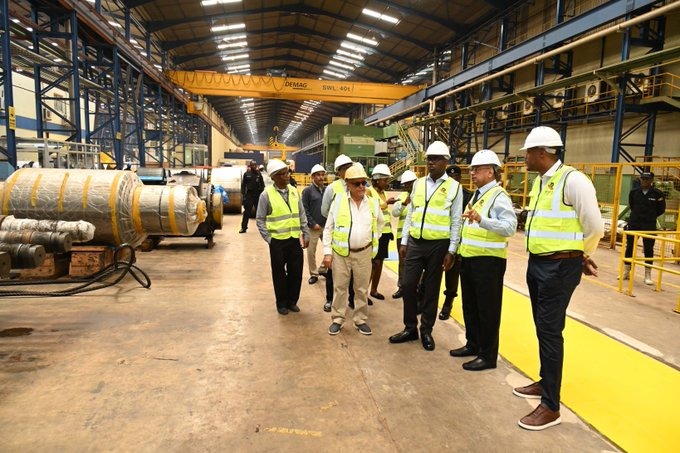
Uganda’s industrialisation drive is set for a major boost following the completion of Roofings Group’s $125 million Ultra-Modern Cold Rolling Mill Complex at the Kampala Industrial and Business Park in Namanve.
The new facility, which was inspected on Friday, August 21, by Finance Minister Henry Musasizi, Energy and Mineral Development Minister Monica Musenero and Uganda Investment Authority (UIA) Director General Robert Mukiza, has an annual production capacity of 150,000 tonnes.
The plant will produce high-value steel products, including pickled coils, Cold Rolled Coils, Aluminium-Zinc Coated Coils and Colour Coated coils, reducing Uganda’s dependence on imported finished steel products while expanding opportunities for exports.
The investment is part of Uganda’s efforts to strengthen local manufacturing, promote value addition, and position the country as a regional industrial hub.
Musasizi said Roofings has become a key player in Uganda’s manufacturing sector, with the company’s combined production capacity standing at 625,000 tonnes annually.
“In 2025, the company recorded Sh400.1 billion in value addition, contributed Sh191.2 billion in taxes and generated Sh229.6 billion in exports, while supporting 2,224 jobs,” Musasizi said.
He added that Roofings’ flat steel manufacturing operations contribute 54 per cent of the company’s total value addition, making it one of Uganda’s leading high-value steel manufacturers.
Government Supports Integrated Steel Value Chain
The Namanve facility is part of Roofings’ wider plan to develop an integrated iron and steel value chain in Uganda, covering mineral exploration, iron ore processing, and finished steel production.
Musenero said the government is supporting the company’s expansion plans, noting that Roofings Rolling Mills Ltd has already received a mineral exploration licence and developed a work programme.
She said the government, through UIA, would help identify suitable land near the company’s existing operations to support a large-scale iron ore processing and steel manufacturing facility.
“As Uganda enters a phase of rapid industrialisation, our first market for steel is Uganda. We must meet domestic demand first and export the surplus,” Musenero said.
She noted that Uganda’s growing automotive industry could provide additional demand for locally manufactured steel, especially automotive-grade products, productscalls for more land, policy reforms
Despite the expansion, Roofings Group has highlighted challenges that could affect future investments and competitiveness.
The company’s Chief Executive Officer, Sheikh Arif, said limited industrial land remains a major obstacle, particularly for a planned downstream rebar factory.
Roofings is seeking an additional 70 acres of land in Namanve to support its expansion programme.
The company also called for government action on delayed refunds of the one per cent Import Declaration Fee and the 1.5 per cent Infrastructure Levy charged on raw materials used for exports.
Roofings further requested a review of tariffs on industrial metal-coating paints and steel billets, arguing that current charges increase production costs.
The company also urged the government to engage East African Community partner states to harmonise taxation and trade measures to create a more competitive regional market, boost to regional manufacturing
The expansion comes as Uganda seeks to transform from a supplier of raw materials into a producer of finished and semi-finished goods.
For steel manufacturers, competitiveness depends on access to affordable raw materials, reliable energy, industrial land, favourable taxation, and regional market access.
The new Namanve complex is expected to increase Uganda’s capacity to produce steel products that are currently imported while opening opportunities for exports across the East African community and beyond.
The government says the investment supports its objectives of job creation, industrial growth, value addition, and export expansion.
However, the success of Roofings’ next phase will depend on how quickly challenges related to land availability, taxation, industrial inputs, and trade policies are addressed.