dfcu uses 62nd anniversary to promote preventive healthcare and community wellbeing
The outreach, implemented in partnership with Obwakyabazinga Bwa Busoga and Rotary Uganda, reflects a growing trend among financial institutions to integrate sustainability and social investment into their business models as they seek to build stronger community relationships and long-term economic resilience.
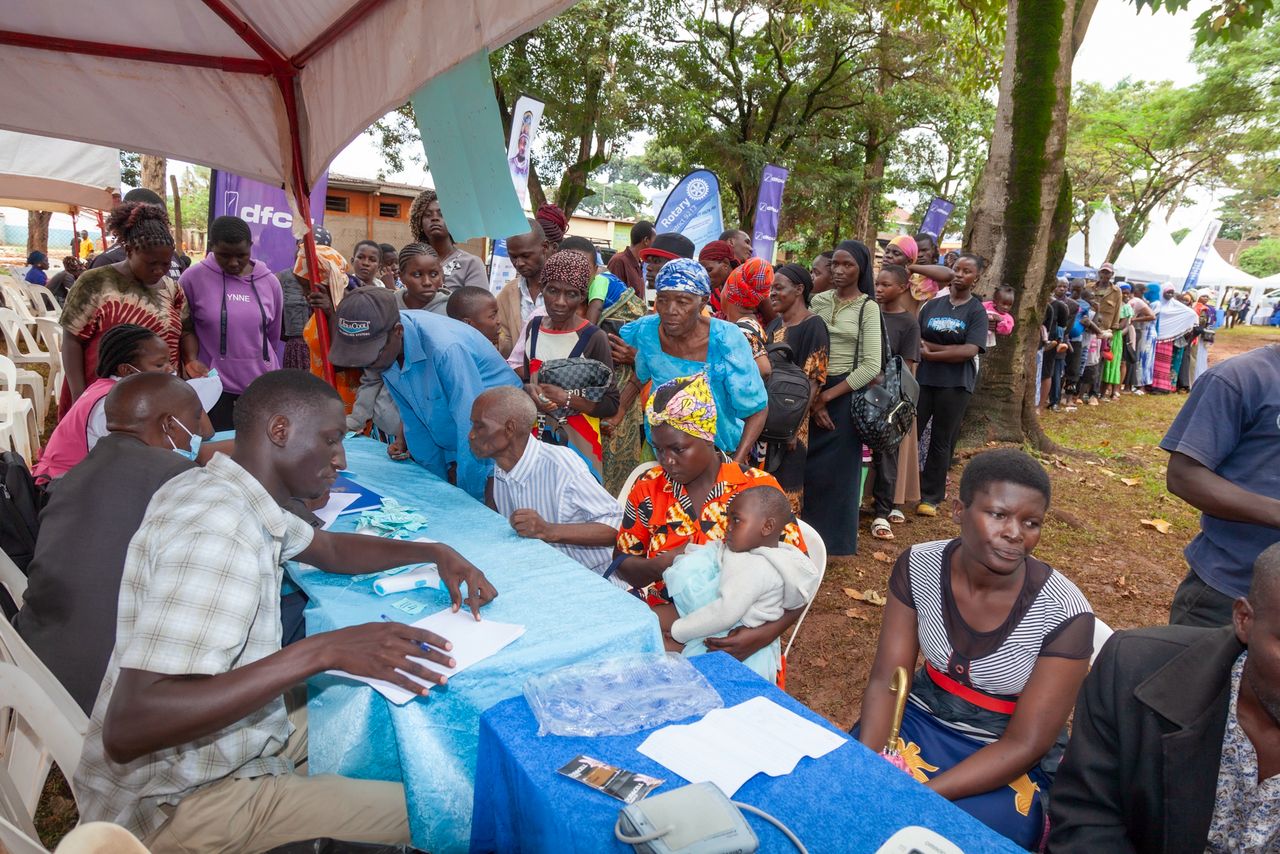
dfcu Bank marked its 62nd anniversary by shifting focus from corporate celebrations to community healthcare outreach, hosting a major free medical camp in Jinja as part of a broader strategy to deepen social impact and strengthen ties with communities across Uganda.
Held at Walukuba West Gardens under the banner of “dfcu Humanity Day,” the initiative attracted more than 1,500 residents who received free medical services ranging from sickle cell screening and cancer testing to HIV services, maternal healthcare, dental care and general medical consultations.
The outreach, implemented in partnership with Obwakyabazinga Bwa Busoga and Rotary Uganda, reflects a growing trend among financial institutions to integrate sustainability and social investment into their business models as they seek to build stronger community relationships and long-term economic resilience.
Speaking during the event, Kate K. Kiiza said the bank intentionally chose community service over a conventional anniversary celebration.
“Today is our 62nd birthday and we chose to celebrate it through dfcu Humanity Day. Instead of holding a traditional corporate celebration, we chose to commemorate this milestone through service to the community,” Kiiza said.
“For 62 years, dfcu has grown alongside Uganda’s economy and people. We believe the long-term relevance of any institution is ultimately defined by the impact it creates beyond business,” she added.
The event highlights how corporate social investment is increasingly becoming part of Uganda’s private sector growth strategy, particularly in areas such as healthcare, education, financial inclusion and climate resilience.
Kiiza noted that healthcare access and disease prevention directly influence productivity, livelihoods and national economic progress, making community well-being a critical component of sustainable development.
The bank placed special emphasis on sickle cell awareness and screening due to the high prevalence of the disease in Eastern Uganda.
The intervention also builds on the bank’s recent “Hope in Motion” Sickle Cell Walk conducted in partnership with Mulago National Referral Hospital to raise funds for sickle cell awareness, training and refurbishment of the hospital’s Sickle Cell Clinic.
Health experts say private sector involvement in preventive healthcare has become increasingly important as Uganda continues to face pressure on public health infrastructure amid rising population growth and disease burdens.
Representing the Kyabazinga of Busoga, Osman Ahmed Noor praised the initiative for addressing critical health challenges affecting communities in the region.
He called for continued investment in interventions aimed at reducing poverty and tackling teenage pregnancy, issues that remain closely linked to healthcare and economic vulnerability.
Meanwhile, Geoffrey Martin Kitakule described the partnership between dfcu Bank, Rotary and the Busoga Kingdom as an example of how institutions can work together to improve community welfare.
“We are delighted to contribute to improving healthcare within the Kingdom because, as the Kyabazinga says, ‘Without a healthy kingdom, you do not have a kingdom,’” Kitakule said.
“This collaboration clearly demonstrates what can be achieved when institutions unite for good,” he added.
The community health camp forms part of dfcu’s wider sustainability and community engagement agenda under its “Going Further, Together” philosophy.
Through the dfcu Foundation, the bank has in recent years expanded investments in education, women entrepreneurship, agribusiness, climate action and financial literacy.
Some of its flagship initiatives include support for women-led enterprises through the GROW programme, agricultural financing, school renovation projects and staff-led volunteer campaigns such as the “60 Acts of Kindness” initiative.
Analysts say Uganda’s banking sector is increasingly moving beyond traditional financial services toward broader socio-economic engagement as competition intensifies and consumers place greater value on socially responsible brands.
Originally established in 1964 as a development finance institution, dfcu has evolved into one of Uganda’s leading indigenous banks with strong involvement in sectors such as agriculture, manufacturing, tourism, education, health and real estate.
The bank says it remains focused on enterprise financing, financial inclusion, women-led businesses, home ownership and agricultural investment as part of its long-term contribution to Uganda’s economic transformation.