How NSSF arrived at the record 22.53% interest rate: The numbers behind the Sh5.44 trillion payout
The real test for the Fund will be maintaining competitive, risk-adjusted returns while protecting members' savings as its asset base grows towards its Sh80 trillion Vision 2035 target.
How NSSF arrived at the record 22.53% interest rate: The numbers behind the Sh5.44 trillion payout
The headline figure of 22.53% is extraordinary. But the more important business question is how the National Social Security Fund (NSSF) arrived at Uganda’s highest-ever interest rate for members.
The answer lies in a year in which the Fund’s investment portfolio generated unusually strong returns, its asset base expanded sharply and total income surged to Sh6.51 trillion.
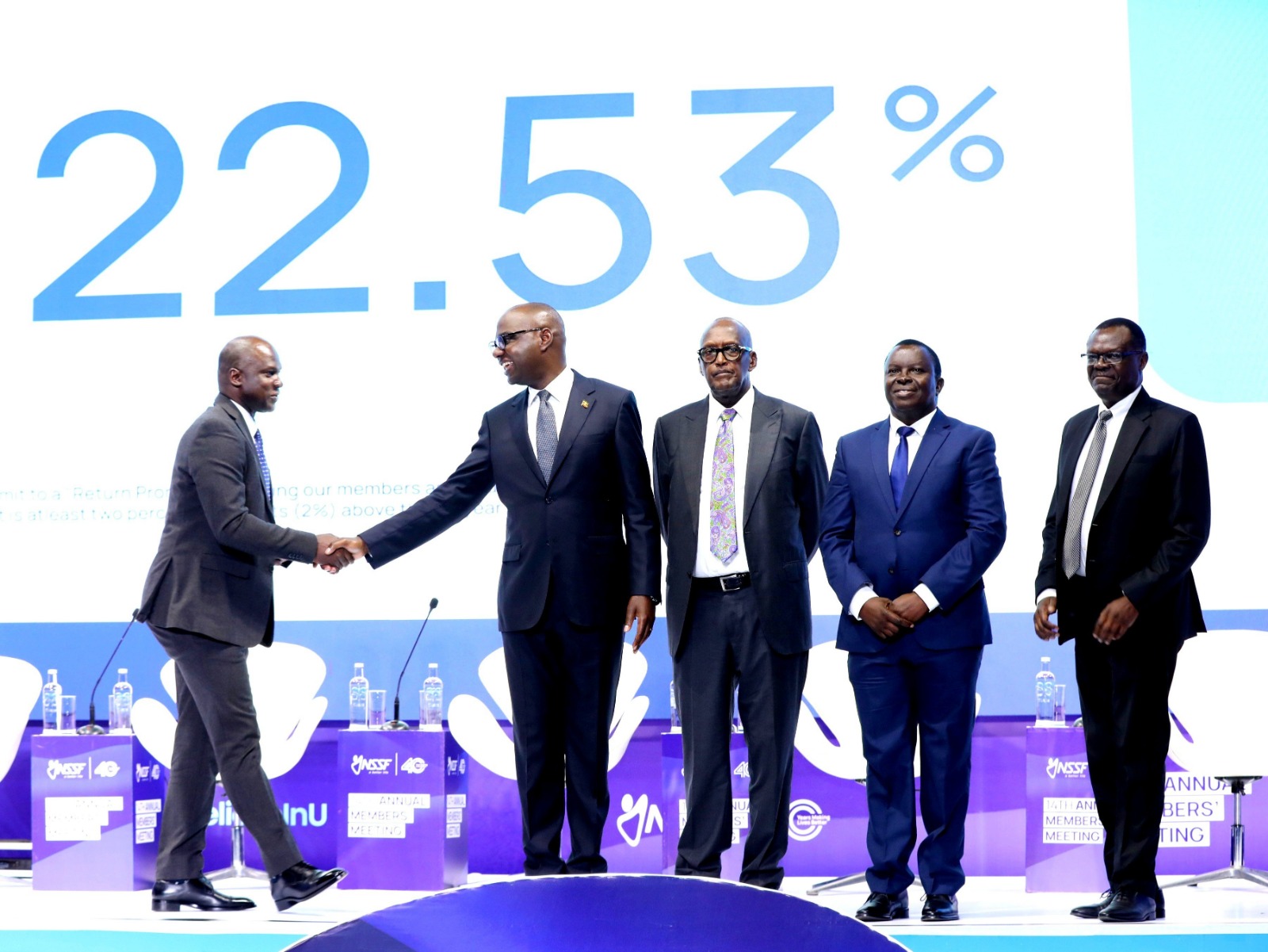
At its 14th Annual Members’ Meeting on September 24, Finance Minister Henry Musasizi declared a 22.53% interest rate for FY2025/26, translating into approximately Sh5.44 trillion to be credited to members’ savings.
That compares with the 13.5% declared for FY2024/25 and about Sh2.79 trillion in interest allocated to members last year.
The 2025/26 rate therefore represents a jump of nine percentage points and an additional Sh2.65 trillion in interest credited to members.
But 22.53% should not be understood as NSSF taking 22.53% of its total assets and paying it out. Nor is the Sh5.44 trillion a cash payment made equally to every member.
It is an annual return allocated to members’ accounts based on the Fund’s investment performance and its established interest-allocation methodology.
NSSF made more money
The starting point was the Fund’s investment performance.
NSSF reported Sh6.51 trillion in total income for FY2025/26, an increase of about 85% from the previous year.
Of this, Sh3.498 trillion came from interest income, while dividend income contributed another Sh369 billion. The Fund’s wider income base also includes other investment-related earnings.
At the same time, assets under management grew by 26.4% to Sh32.87 trillion, giving NSSF a much larger pool of capital from which to generate investment income.
This is important because NSSF is fundamentally an investment institution. It collects members’ contributions and invests them across asset classes, with the objective of generating competitive long-term returns.
Where did the investment returns come from?
The portfolio’s structure provides an important clue. During FY2025/26, 76.8% of NSSF’s investment portfolio was in fixed income, 18.4% in equities and 4.8% in real estate.
Fixed income, principally government securities and other debt instruments, remained the portfolio’s anchor.
That matters because Uganda’s relatively attractive interest-rate environment provided an opportunity for NSSF to earn substantial income from bonds and other fixed-income investments.
But the record return was not produced by bonds alone. NSSF’s investment review says every major asset class contributed to the year’s performance.
Fixed income provided dependable returns, equities benefited from a broad recovery in regional stock markets, while real estate continued to provide long-term value.
This combination is important. A pension fund of NSSF’s size does not rely on one investment for its annual return; it spreads members’ money across different assets to balance risk and return.
The Fund had a much larger asset base
Another part of the calculation is scale. NSSF’s assets increased from approximately Sh26.01 trillion in June 2025 to Sh32.87 trillion in June 2026.
That represents an increase of about Sh6.86 trillion in one year.
The growth was driven by both continued contributions and investment income. During the year, NSSF collected Sh2.42 trillion in contributions, while paying Sh1.55 trillion in benefits to members.
In other words, NSSF was not only earning returns on investments; it was also receiving fresh money from employers and members that could be invested.
The 22.53% is an allocation to members
This distinction is crucial. NSSF’s investment performance generates income for the Fund, but the entire amount of reported income is not automatically distributed to members.
The Fund has operating costs, taxes and other expenses. It must also maintain reserves and meet its obligations.
NSSF’s FY2025/26 figures show that it paid Sh301 billion in income tax, while its cost of administration remained below one per cent of assets. The Fund reported an administration cost of 0.84% and a cost-to-income ratio of 7.7%.
Therefore, the Sh5.44 trillion credited to members should be viewed as the amount allocated after considering the Fund’s overall financial performance and the requirements of its investment and financial management framework.
NSSF’s own historical reporting explains that the annual interest declared represents the Fund’s performance after taking account of income earned and expenses incurred during the period.
Why was the rate so much higher this year?
The simplest explanation is investment performance combined with a much larger asset base.
NSSF’s Chief Investment Officer described FY2025/26 as a landmark year, saying the portfolio delivered a 22.53% return to members. Fixed income benefited from attractive yields, equities were lifted by stronger regional markets and real estate added long-term value.
The result was a dramatic increase in the amount available to members.
The rate also significantly exceeded inflation. Musasizi said June 2026 inflation was 3.7%, while the 10-year average was 4.1%. The NSSF investment review similarly describes the 22.53% return as producing a substantial positive real return for members.
For members, that means their savings increased substantially faster than consumer prices during the year.
The bigger business story
The record rate is therefore less about a one-off windfall and more about the growing financial scale of NSSF.
The Fund now manages Sh32.87 trillion, collected Sh2.42 trillion in contributions during the year and invested across fixed income, equities and real estate.
Its challenge is whether such performance can be repeated.
A 22.53% return should not automatically become an expectation for every future year. Investment returns fluctuate with bond yields, interest rates, equity markets, exchange rates, property valuations and broader economic conditions.
Indeed, NSSF’s own investment reporting stresses the long-term nature of its investment strategy.
The significance of the 2025/26 result is therefore twofold: members receive a record Sh5.44 trillion in additional savings, while NSSF demonstrates the financial power that can emerge when a large pool of long-term savings is professionally invested and compounded over time.
The real test for the Fund will be maintaining competitive, risk-adjusted returns while protecting members’ savings as its asset base grows towards its Sh80 trillion Vision 2035 target.