
Coffee export earnings fall 18.6% as drought and global supply hit Uganda: agriculture ministry positive
The combination of increased supply and changing market conditions has created short-term price pressure for producers, including those in Uganda.
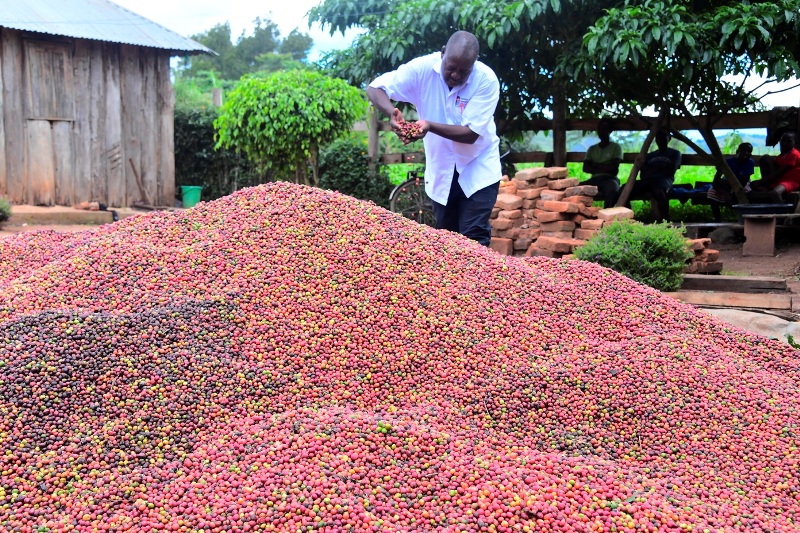
Uganda’s coffee and cocoa farmers have been urged not to panic over recent declines in commodity prices, with Agriculture Minister Frank Tumwebaze describing the downturn as a temporary global market adjustment rather than a sign of weakening demand.
Tumwebaze, in a statement issued on September 20, 2026, said the fundamentals underpinning Uganda’s coffee and cocoa sectors remain strong and projected some price recovery and stabilisation over the next six months.
“Do not be discouraged. The drop in prices is temporary and doesn’t reflect loss of demand,” Tumwebaze said.
Global supply weighs on prices
The minister attributed the recent volatility largely to increased global supply.
In coffee, the arrival of Brazil’s completed harvest and rising exports from Vietnam have increased supplies on the international market, putting downward pressure on prices.
The cocoa market has also been affected by higher production, with Ivory Coast recording a reported 30% increase in its cocoa harvest.
The combination of increased supply and changing market conditions has created short-term price pressure for producers, including those in Uganda.
Drought hits Uganda’s coffee output
While global supply has been the major driver of the price correction, Uganda’s coffee sector is also facing domestic production challenges.
Tumwebaze said prolonged drought and high temperatures in coffee-producing areas including Greater Masaka, Kyotera, Sembabule and Luwero have caused water stress, reducing processing out-turn and quality by roughly 10%.
The weather shock has also affected export volumes.
Uganda’s coffee export volume in July 2026 declined by 15% compared with July 2025, while export earnings fell by 18.6%, from US$250.7 million to US$204.1 million, according to the minister.
The decline highlights the dual pressure facing the sector—volatile international prices alongside climate-related production constraints.
Coffee prices remain above break-even
Despite the recent correction, Tumwebaze said current prices remain favourable compared with production costs.
By early September, Robusta FAQ prices had fallen by about 14.5% to between Shs11,500 and Shs12,000 per kilogramme, compared with the previous period.
However, the price remained above the sector’s estimated break-even benchmark of Shs7,000 per kilogramme, meaning farmers were still operating above the stated profitability threshold.
Arabica parchment, meanwhile, was trading at between Shs15,500 and Shs16,000 per kilogramme, representing an 8.5% increase compared with September 2025.
The year-on-year comparison suggests that, despite recent volatility, coffee prices remain relatively strong compared with the same period last year.
Quality becoming increasingly important
The changing market conditions are also making quality a more important factor in determining the prices farmers receive.
Tumwebaze said traders were becoming more selective, with better premiums being offered for properly harvested and well-dried coffee beans.
He urged farmers not to respond to the price volatility by harvesting immature coffee, warning that poor-quality beans could undermine Uganda’s competitiveness in international markets.
Traders, he added, should maintain transparent and quality-based pricing to protect the reputation of Ugandan coffee.
Government steps up climate resilience
The government is also pursuing measures to reduce the impact of climate-related shocks on agricultural production.
Tumwebaze said government was distributing subsidised fertilisers under a Presidential Directive while scaling up farmer-managed irrigation schemes through an inter-ministerial partnership.
The interventions are intended to improve farmers’ resilience to drought and high temperatures while supporting productivity and quality.
Six-month outlook
Despite the recent turbulence, the Ministry expects coffee and cocoa prices to recover slightly and stabilise over the next six months.
The outlook comes as Uganda seeks to strengthen the resilience of two important agricultural export commodities amid changing global supply conditions and increasingly unpredictable weather.
Tumwebaze’s message to farmers and traders is therefore one of caution rather than panic: the current price decline is being treated as a market correction, while Uganda’s production potential, export demand and long-term sector fundamentals remain intact.